by UFO History Buff & Author, Charles Lear
 Brazil has a history of official UFO investigation almost as long as that of the United States. However, it has an official policy on disclosure that predates the U.S.’s by more than a decade. In 1954, the Brazilian Air Force started The First Confidential Inquiry into Unidentified Aerial Objects in response to the first major flap in that country. In 1969, the Sistema de Investigação de Objetos Aéreos Não Identificados (SIOANI) was established, and nearly 100 detailed case files were accumulated up until its termination in 1972. After this, in 1977, in response to reports of injuries and deaths as a result of UFO encounters in the area of Pará (mainly in Colores) Operação Prato was authorized by Colonel Protásio Lopes de Oliveira. This resulted in more than 2000 photos, 16 hours of film, and a 179-page report. The First Confidential Inquiry, SIOANI and Operação Prato files were classified for decades, but thanks to a freedom of information campaign begun in April of 2004 by the Brazilian UFOlogist and publisher of UFO Revista, Ademar José Gavaerd, many of the files were shown to him and other UFOlogists in 2005 as a prelude to releasing them to the general public. Then, in 2010, Brazil issued Ordinance 551/GC3, requiring every branch of the military and aviation sectors to collect and transfer all UFO reports to the Aerospace Defence Command in Brasilia along with any material proof by way of photos or video on a yearly basis. There, it is to be catalogued and made available to the public. Along with this, since 2012, the Air Force has periodically released declassified files through the Brazilian National Archives, and recently released 893 reports in May of this year. In this blog, we’ll look at the history of the Air Force investigation, the efforts of Gevaerd and other UFOlogists to gain access to the case files, and some of the most interesting (at least to us) cases (translated files can be found here) found within them.
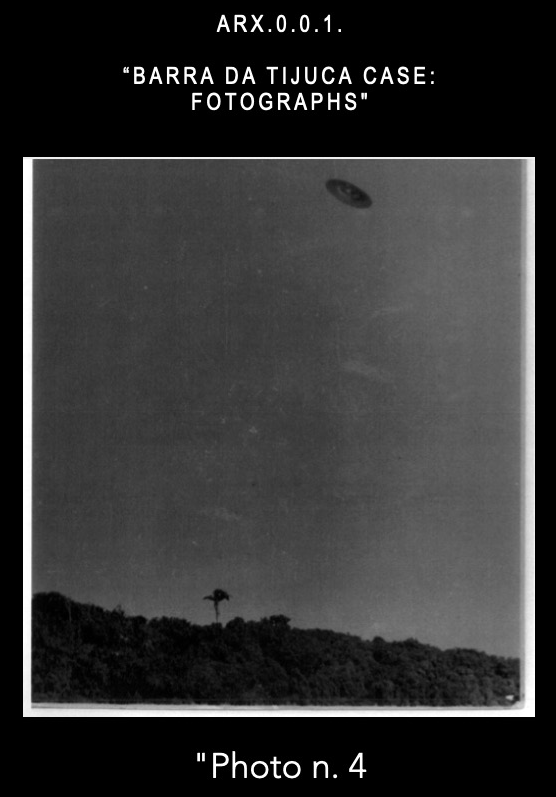 One case of note that Oliveira was involved with concerned a series of five photos of a flying saucer taken in Barra Da Tijuca in 1952 by Ed Keffel and published in O Cruzeiro on May 24th of that year. In his front page story in the October 1961 APRO Bulletin, Fontes describes Keffel being present at AF headquarters, along with O Cruzeiro reporter João Martins, at a meeting called by Oliveira in 1954 where Fontes and the others were invited to be interviewed and present evidence.
SIOANI was created within the 4th Air Zone Command. It was sponsored by the commander, Brigadier José Vaz da Silva, and coordinated by Major Gilberto Zani de Mello. There were two bulletins released: Bulletin 1 in March 1969 and Bulletin 2 in August 1969. According to Pratt, SIOANI was shut down after Mello retired.
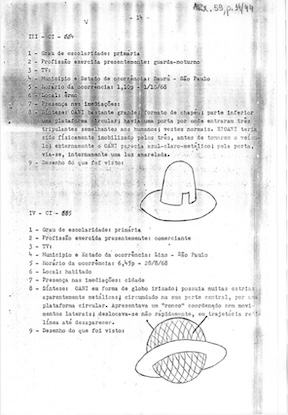
There is a case in Bulletin 1 involving humanoids and physical contact reported to have taken place in São Paulo on August 28, 1968. According to the report (page 14 of the pdf), the witness saw a person wearing “yellow pants and a T-shirt” standing 100 meters from a power plant and asked him to move away. The person told him, “I am waiting for companions who are hunting.” Two days later, he saw the same person in the same spot, and he was wearing “a yellow blouse and clear pants.” He saw another person in dark clothing looking at him through a window in the “Central” (power plant?). The witness happened to have been carrying a piece of conduit and swung twice at the first person and missed. The person in the Central came out by “passing through the window” and helped the other “dominate the witness.” The witness was lifted up and dropped several times, and then the first person slapped him on the back and said, “go away, you tramp, that [sic] we will return when this work is over.” As the witness ran away, he saw a light blue, metallic, hat-shaped object with a door. There was a yellow light coming through the door and he could see three “crew members,” which included the two he encountered, as they closed it. He then heard a “frying noise initiating the movement of the UFO.”
An early example of the Brazilian Air Force’s willingness to be forthcoming with its information was in 1986, when Minister of Aeronautics, Brigadier Octávio Júlio Moreira Lima, held a press conference on May 23rd to tell reporters that five Brazilian Air Force FAB fighter jets had chased 21 UFOs (some reportedly as big as 100 meters in diameter) seen by both civilians and military personnel and detected on radar. The written report, however, wasn’t made available until 2009.
 As mentioned before, it was because of the efforts of A. J. Gevaerd and other Brazilian UFOlogists that Brazil’s official UFO files became available to the public. Their main interest was in the files generated during Operação Prato, although, according to Pratt, documents leaked in the 1990s were already in the hands of the “400 to 500 active Brazilian UFOlogists.” He says that he was given about 400 pages, including 18 photos of UFOs, and he presents some of the material in his report, which predates the official release of the documents. The man who headed the operation, Captain Uyrangê Hollanda, decided that he was no longer obligated to remain silent after his retirement as a Lieutenant Colonel and began speaking publicly in 1997.
The operation was begun in response to complaints by several mayors in the Colares area that their villages were under attack by UFOs. Many people reported being burned, some reported having blood taken from them (which spawned the term “chupa-chupa” for some of the UFOs), and Wellaide Carvalho, a doctor who told Pratt she had treated 40 UFO burn victims, said that two of them had died.
According to Pratt, during meetings with Gevaerd and other UFOlogists at military headquarters in Brasilia on May 20, 2005, “three top generals acknowledged that the Air Force had long been concerned about UFOs and had systematically tracked them – known as “H” traffic – since 1954.” He says that, according to Gevaerd, Air Force leaders “(1) recognized the importance of UFOlogy, (2) pledged to help get classified files opened to the public, and (3) guaranteed that steps would be taken to form a joint committee of military and civilian UFO researchers to study the phenomenon.”
During the meetings, Gevaerd and six other UFOlogists were allowed to examine Air Force UFO files that included some from Operação Prato. Pratt explains that even though the meetings were promising, before the documents could be made public, approval had to be given by the chief of the Air Force, the defense minister, and Brazil’s president, Luiz Inácio Lula da Silva. The approval was given, and Ordinance 551/GC3 was signed on August 9, 2010, by Air Force Commander Lt. Brigadier Juniti Saito and published on August 10, 2010.
Thanks to Scott Bernewitz for bringing our attention to this subject.
Podcast: Play in new window | Download