by UFO History Buff & Author, Charles Lear
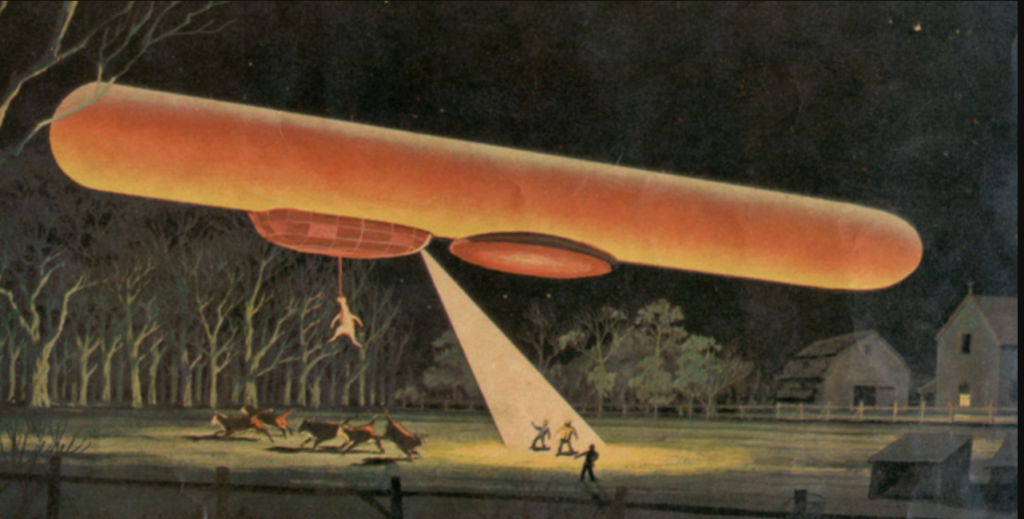 The cattle mutilation mystery and its association with UFO activity didn’t get the attention of researcher investigators until the 1970s. There is an article on page 2 of the March 1975 APRO Bulletin, headlined “More on Mutilations,” discussing the findings of APRO Field Investigators Bill Pitt, Lee Spiegel, and Kevin Randle. It was the opinion of APRO at the time that “no satisfactory evidence has emerged which links UFOs to mutilated animals.” The first mutilation to get the public’s attention was that of a horse named Snippy found by its owners in the San Luis Valley of Colorado on September 8, 1967. Shortly after that, in his article (page 8 of the pdf) in the July/August 1968 Flying Saucer Review headlined “West Virginia’s Enigmatic Bird,” John Keel mentions that cow and horse mutilations are “now common” in the midst of sightings of the Mothman and UFOs in the area around Point Pleasant. However, there is a report far earlier than this that, by most accounts, appeared in the April 23, 1897, Yates Center Farmer’s Advocate. This involves a mystery airship caught in the act of abducting a cow right in front of prominent Woodson County, Kansas, citizen Alexander Hamilton (not the one on the 20-dollar bill). While the Advocate article remains elusive, Redditt user Remseey2907 found an article in what appears to be the Globe Democrat that includes the details of and references the Advocate article.
According to the Democrat article dated April 26th and headlined “The Airship Steals,” Hamilton, a farmer who lived near Yates Center, said that “last Monday at 10:30 o’clock,” (April 19th) he and his family “stood mute in wonder and fright” as an airship appeared and proceeded to, in the reporter’s words, “swoop down upon the cow lot and steal a 2-year-old heifer.” Backing up Hamilton’s story is an affidavit signed by eleven prominent citizens, including a sheriff and a justice of the peace, stating that they believe Hamilton’s story “to be true and correct.”

The details of the story are presented in Hamilton’s words. According to him, “we were awakened by a noise among the cattle.” He got out of bed, went to the door thinking that his bulldog “was performing some of his pranks,” and was astonished to see an airship coming down over his cow lot “almost forty rods from the house.”
He called his son, Wall, and his tenant, Gid Heslip, and after grabbing some axes, they “ran to the corral.” When they were about fifty yards from the ship, it was no more than thirty feet above the ground. Hamilton describes it as cigar-shaped, about 300 feet long, with a carriage underneath “made of panels of glass or other transparent substance, alternating with a narrow strip of some material.” The rest of the craft was dark red.
It was brilliantly lit from within and had three external lights: “an immense searchlight,” and two smaller lights, one red and one green. The searchlight was pointed directly on Hamilton and the others and then “a great turbine wheel about 50 feet in diameter, which was slowly revolving below the craft, now began to buzz…”
The craft rose up, and when it was about 300 feet high, it appeared to be hovering over a two-year-old heifer that seemed to be stuck to a fence. They went over to her and saw there was a half-inch red cable tied in a slip knot around her neck that went up to the ship. They tried to free the cow but were unable to, and they watched as the ship rose up and carried the cow away towards the southwest.
According to Hamilton, Link Thomas of Coffey County, about four miles west of LeRoy, Kansas, found the hide of the cow, along with its head and legs, in his field on Tuesday. Hamilton was able to identify it by his brand on the hide.
This story got widespread public exposure thanks to Frank Edwards’s bestselling 1966 book, Flying Saucers–Serious Business, and Jacques Vallée included it in his 1965 book, Anatomy of a Phenomenon, and his 1969 book, Passport to Magonia. It seems, however, that the story was a hoax and how this was discovered is told in detail by Jerome Clark in his article (page 94 of the pdf) headlined “The Great Airship Hoax,” published in the February 1977 issue of Fate magazine.
According to Clark, “the truth about the affair” came out in an article published in the January 28, 1943, Kansas newspaper, the Buffalo Enterprise. A week before, the paper had recounted Hamilton’s original tale, and this prompted Ed F. Hudson, who had been the editor of the Farmer’s Advocate in 1897, to write a letter to the Enterprise. According to Hudson, he had just installed a small gasoline engine to replace hand power on his “old Country Campbell press” and invited friends, including Hamilton to watch it operate. Hudson explains the origin of the story: “Hamilton exclaimed, ‘Now they can fly,’ hence the airship story that we made up.”
Clark says the Enterprise article was discovered in 1976 by an American correspondent of Fortean Times Editor J. M. Rickard. Rickard sent Clark a copy, and Clark got a letter seeking confirmation published in the September 16, 1976, Yates Center News. This got a reply from Donna Steeby of Wichita, Kansas who said that her 93-year-old mother, Ethel L. Shaw, had heard the story from Hamilton, himself. Shaw provided Clark with a statement.
According to Shaw, when she was about 14 years old, she was at the Hamilton house with Mrs. Hamilton and their daughter, Nell, when Mr. Hamilton came in and said “Ma, I fixed up quite a story and told the boys in town and it will come out in the Advocate this weekend.” Mrs. Hamilton was “rather shocked” by the story but the girls weren’t bothered “as we felt it was just a fabricated story.”
Shaw goes on to say that “it seems there were a few men around who had formed a club which they called ‘Ananias’ (Liars’ Club).” To her knowledge, the club broke up not long after the story was published. She adds that the men who signed the affidavit “knew it to be a falsehood but simply went along with it for the fun.”
According to Clark, Lucius Farish had an article about the case published in the April 1966 issue of Fate in which he proclaimed “this case (is) one of the most astounding to be found on record!” The editor’s note at the end of Clark’s article states: “Lucius Farish has asked us to convey his apologies to Fate readers for his unwitting role in publicizing this fallacious incident.”
Thanks to Redditt user tweedboltmegacorp for posting the link to the Fate issue.
Podcast: Play in new window | Download