by UFO History Buff & Author, Charles Lear
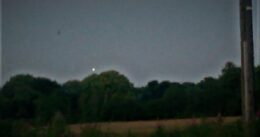 It’s always a plus when UFO cases come along with physical evidence to back them up. Sometimes this evidence is in the form of physiological effects on the witnesses, and cases involving these are numerous enough that investigators have been able to focus on them as a specific area of study. Conjunctivitis (burning red eyes), nausea, hair loss, numbness, paralysis, and burns are some of the symptoms commonly described, but a very unusual effect was reported in the following 1976 case from Bolton, England.
While the incident was said to have occurred in 1976, it didn’t show up in major media until 1987. In the March 1987 issue (page 19 of the pdf) of She magazine, there is an article by Peter Hough headlined “The UFO in Armadale Road.” According to Hough, at 5:15 p.m. on January 23, 1976, 17-year-old Shelley McLenaghan had just gotten off a bus and was 100 yards from home when she saw a UFO. She is quoted as saying, “Before that, I would have thought anybody who said they’d seen a UFO was crazy.” She added, “I think the government know far more than they let on.”
McLenaghan is then quoted describing her encounter:
I saw a red and green light in the sky, thought ‘what’s that?’- it was a bit weird. The lights were about four or five times the size of a star. Then, as if they’d said, ‘we’ll catch your eye with the space ship,’ the lights merged and the semblance of a real nuts-and-bolts craft zoomed in. It was the size of a small house, flat on top, with sloping sides and sloping underneath, with a trap door, tripod legs. It was spinning on an axis, then righted itself, I could see portholes with light shining through.
Suddenly, it tilted towards me, then there was a terrible pressure on my head and shoulders, an off taste in my mouth. My teeth seemed to vibrate. When I tried to run it was like being in a nightmare. My arms and legs moved, but in slow motion. I tried to scream, nothing came out. Then everything went hazy until I remember bursting through the side door at home.
Mother was cooking tea. She gave one look at me, then said ‘What on earth’s happened?’ She thought I’d been raped. I grabbed her arm, dragged her outside and pointed at the sky, but whatever it was had gone. We went back into the kitchen and I started to calm down. Then I noticed the time – ten minutes past six. A ten-minute walk had taken me 45 minutes.
According to Hough, when McLenaghan’s father got home that night, the family called the Bolton Police, who didn’t believe Shelley’s story and suggested she had misidentified a low-flying plane.
Over the weekend, McLanaghan developed a rash that covered her upper body from the neck down. Along with this, her eyes hurt, her joints ached and “she had problems with her mouth.” She went to a doctor who told her mother that the symptoms were due to hysteria and a means to get attention. However, a dentist she went to thought otherwise and was puzzled by the condition of her teeth: her top fillings had come out, and her bottom fillings had turned to powder. Hough describes this as being what would come from a serious head injury like one might get from a car accident.
According to Hough, the family was visited by two men eleven days later at 7:00 p.m. in the midst of a downpour. They were “an odd couple,” and one of them said he was an RAF commander. Hough points out that that rank only exists in the Navy. The “commander” was around 40, had fair hair, only one arm, and “did most of the talking,” while the other man was dark-skinned, small, and sat silently with “a black box on his knee.” This man said it was a tape recorder, but reportedly never changed a tape in the course of a four-hour discussion.
McLenaghan said the “commander” gave her a “grilling” calling her a liar, “stupid enough to wrongly identify a weather balloon,” and just looking for publicity. She told him that the Bolton Evening News and Granada TV must have heard about her sighting from the police and that she hadn’t cooperated with them, and “he seemed placated.” He said this was good and insisted that she, in her words, “not mention it to anyone – especially UFO organizations.”
McLenaghan describes being pushed to the point of breaking down, at which point the “commander” would talk to her parents “about something trivial.” She says the men “had a strange effect on all of us,” and that her father, who was normally protective, “sat by while this man was tearing me to pieces.” She says the man seemed to know about her rash even though the family hadn’t said anything about it. Hough adds that when her father asked for identification, the men evaded the issue and then said “We investigate these sort of things.” They then drove off in a black car.
 According to Hough, McLenaghan agreed to help him and Jenny Randles “reopen the case,” and he recounts McLenaghan’s experiences under hypnosis. She described herself lying on a table in a strange room with, in Hough’s words, “a figure with long blond hair” examining her feet. She then found herself running home.
Hough says that during a second session, McLenaghan said she was talked to by the “commander” twice. She is quoted as saying, “But I can’t say anything about the hypnosis because I wasn’t conscious. Maybe it was something like a nightmare.”
What is noteworthy here is that Randles was the director of investigations for the British UFO Research Association from 1981 until 1993 and instrumental in getting a moratorium put into place starting in 1988 on the use of hypnosis in investigations by BUFORA members. She and Hough wrote several books together covering UFOs and the paranormal.
The article ends with a final quote from McLenaghan: “If anyone has an experience they can’t put in a box, file away and take out as a normal memory, they’re bound to ask just what happened. Why did they choose me?”
In a box below the article, Randles is quoted explaining why McLenaghan’s case was re-investigated: “Because the information is verifiable via other people, for example Shelley’s parents, and also because of the associated effects of the sighting – Shelley’s rash and crumbled fillings. One odd aspect is the medical silence over these; we have asked in vain to look at Shelley’s medical records of the time.”
This case is included in A Catalogue of UFO-Related Human Physiological Effects (page 69 of pdf) published in 1996 by John Schuessler, and in Jacques Vallée’s 1990 book, Confrontations. Accounts can also be found in the March 22, 1988, Weekly World News, and the July 30, 1987, Australasian Post.
Podcast: Play in new window | Download
I just came across this case in our records published in the Australian International UFO – Flying Saucer Research newsletter, May 1988. It’s an intriguing case with Shelley’s dental fillings being affected as they were, but nothing surprises me any more when it comes to the UFO subject. Thank goodness it was republished. Goes to show the importance of record keeping for posterity.