
by UFO History Buff & Author, Charles Lear
Among the many possible explanations for UFOs is that some UFOs might be creatures that live in the sky. The person who became best known for this idea was Trevor James Constable who presented it, along with infrared photos of what he claimed were bioforms invisible to the naked eye, in his 1958 book (as Trevor James) They Live in the Sky. James wasn’t alone in his belief, and the concept of sky creatures goes back farther than 1958 in both speculative literature and science fiction.
A good starting point for the history of the sky-creatures hypothesis is the 1997 paper by Jerome Clark, Spacemen, Demons and Conspiracies, published by the Fund for UFO Research. Clark explores the many explanations for UFOs put forward throughout the years and looks at the SCH in the section “Secret Weapons and Space Animals.” After going into the speculation by people such as James Moseley, Leon Davidson, and Jacques Vallée that flying saucers/UFOs can be explained as classified secret weapons, Clark delves into the history of the sky-creature concept.
 According to Clark, sky creatures originally appeared in fictional form, possibly for the first time, in the story by Sir Arthur Conan Doyle, “The Horror in the Heights,” published in the November 1913 issue of The Strand Magazine. The first person to offer the speculation that our skies might truly be full of living creatures was Charles Fort in his 1923 book, New Lands, in what Clark calls “a casual aside.” Fort wrote, “It seems no more incredible that up in the seemingly unoccupied sky there should be hosts of living things than that the seeming blank of the ocean should swarm with life.” In his 1931 Book, Lo!, he wrote, “Unknown, luminous things, or beings, have often been seen, sometimes close to this earth, and sometimes high in the sky. It may be that some of them were living things that occasionally come from somewhere else.”
After Kenneth Arnold’s June 24, 1947, sighting, on July 7, John Phillip Bessor wrote the Army Air Forces giving his opinion that what Arnold and the many others that followed him had seen were “a form of space animal, or creature, of a highly attenuated (ectoplasmic?) substance, capable of materialization and dematerialization, whose propellent is a form of telekinetic energy.” Bessor posited that their presence might explain blood and meat falls reported throughout history (Fort wrote about such events), and in the assumption that they were hostile predators with a taste for human flesh, might explain missing persons.
As silly as Bessor’s theory might seem, according to Clark, an Air Force spokesman replied to Bessor saying it was “one of the most intelligent theories we have received.” In a 1949 summary of Project Sign’s investigations it was noted, “Although the objects as described act more like animals than anything else, there are few reliable reports on extraterrestrial animals.” Clark adds that aerospace engineer Alfred Loedding who worked with Project Sign as a civilian (he was a core member when it was established), is quoted in the October 10, 1954, Trenton Times-Advertiser as saying, “I suspect that [UFOs] may be a kind of space animal.”
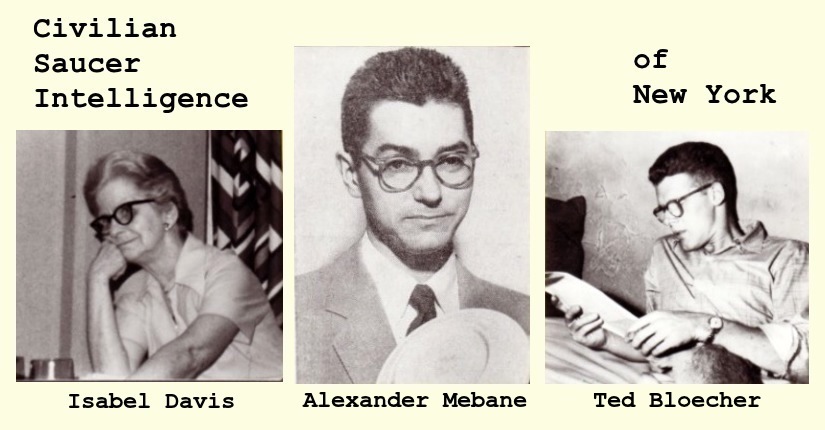 Much of Clark’s paper seems to have been sourced from the December 15, 1957, Civilian Saucer Intelligence of New York newsletter. CSI-NY was a science-minded organization founded in 1954 by Isabel Davis, Ted Bloecher, and Lex Mebane. On page 31 of the news letter is the article (page 33 of the pdf) headlined “Who ‘Discovered’ Space Animals?” which has most of the same information provided by Clark. Clark references another CSI article on the subject that appeared in the September 1957 issue of Fantastic Universe.
The newsletter article begins with a reference to the Fantastic Universe article: “After we’d written an article for the September Fantastic Universe suggesting that ‘angel hair’ might be interpreted as organic tissues cast off by stratospheric creatures, we began to wonder who was the first to think of UFOs as animals.”
Ivan T. Sanderson is the first person mentioned as possibly being the “most eminent advocate” of the idea at the time and is said to have been “principally influenced” by an article by Countess Zoë Wassilko-Serecki published in the September 1955 American Astrology. Clark provides an excerpt and says her article was the most influential of all articles written on the subject because it “gave the theory concrete shape.” It’s summed up in the CSI newsletter this way: “This theory postulated ionospheric, energy-feeding, quasi-electrical entities.”
According to the CSI article, others came up with their own sky creature theories at about the same time. French engineer Rene Fouéré published his theory in the summer 1954 Paris-Montparnesse that UFOs were “disc beings,” Commander Walter Kerig suggested that UFOs behaved more like “puppies” than spaceships, and Desmond Leslie suggested in Flying Saucers Have Landed that, in the CSI reporter’s words, “the cylindrical UFO of Oloron-Gaillac might have been a huge living thing.”
The CSI article brings up the same early post-1947 theorists as Clark and adds Arnold to the list: “Sometime during this period, too (we don’t have definite references), the idea was first publicly advanced by pioneer saucer investigator Kenneth Arnold.” A search on our part came up with a quote from Arnold in the article by Fred Schneiter headlined “Eerie Blue Light Said Live ‘Thing’” in the January 29, 1955 issue of The Observer out of La Grande, Oregon: “I believe that whatever they are, they are living organisms, and not controlled by any type of Man from Mars.” Going back farther in time, the CSI article, like Clark’s, ultimately attributes Charles Fort with the origin of the SCH and includes the same quote from New Lands at the end.
 The Civilian Saucer Intelligence article on the subject that appeared in the September 1957 issue of Fantastic Universe is mostly about the angel hair phenomenon. The first part of a series headlined “Shapes in the Sky,” it begins with a description of an investigation by CSI of an angel hair report begun after the witness had contacted Ivan T. Sanderson. Other contemporary cases are described with the source provided for each of them, and then there are several more cases presented going back to 1741. The reader is told that the latter cases were “mostly taken from Fort, but we quote in all cases from the original reference.” This all leads to the speculation that angel hair might come from “live large flocks of spherical entities or creatures, about six feet in diameter,” which the authors admit “is un-questionably in conflict with present scientific view of what is possible.” The two possibilities offered are that these “jellybirds” shed their appendages after mating, or “burst open” after death leaving behind their “cobwebby” remains.
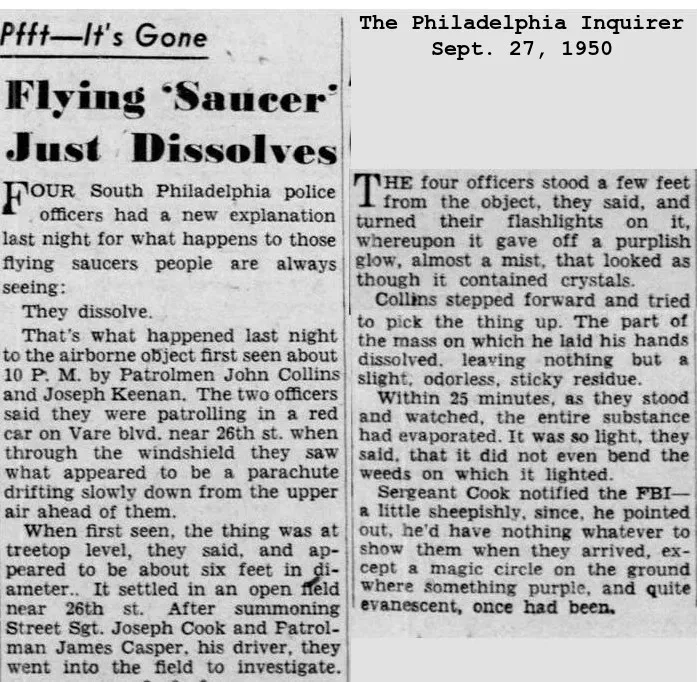
A 1950 case in Philadelphia is referenced that is said to have been described in the 2nd of the “Shapes in the Sky” series published in the May 1957 issue of Fantastic Universe. Clark also described this case in his article and its source is the September 27, 1950, Philadelphia Inquirer. According to the article “Flying ‘Saucer’ Just Dissolves,” at around 10 p.m. the night before, Patrolmen John Collins and Joseph Keenan spotted what seemed to be a parachute and watched through their patrol-car windshield as it settled into a field near 26th Street and Vare Boulevard.
They called in Street Sergeant Joseph Cook and Patrolman James Casper, and the four of them went to investigate. According to them, when the object was hit by the light of their flashlights, “it gave off a purplish glow, almost a mist, that looked as though it contained crystals. Collins went to pick it up and the area where he made contact dissolved and left a sticky, odorless residue. Within 25 minutes the entire object, which was so light it didn’t even bend the reeds it sat on, dissolved. Cook notified the FBI, but there was nothing to show but “a magic circle on the ground where something purple, and quite evanescent, once had been.” According to many sources, including the Classic Movie Hub blog, the case was the inspiration for the 1958 movie, The Blob.
As for sky creatures appearing as movie monsters, it wasn’t until 2022 that such a creature was featured in a major film. This creature has the un-monster-like name of “Jean Jacket” and is the nemesis of Earth-bound humans in Nope.
Podcast: Play in new window | Download