by UFO History Buff & Author, Charles Lear
 In last week’s blog, we looked at a case involving a 13-year-old boy (the investigators chose to keep him and his family anonymous) who said that on December 4, 1980, he saw a UFO and was hit in the chest by a beam of light from it that temporarily paralyzed him. The case was investigated by Joe Nyman and Ed Fogg of the New England UFO Study Group, and they wrote a report that was published on the front page of the January 1981 issue of the group’s publication, the New England UFO Newsletter. After the investigators told him to look for any unusual marks, the boy discovered a red mark on his chest, which they saw and photographed. During questioning, it came out that during his encounter, he had heard squeaky mumbling noises in his head that varied in pitch “like a two-year-old would do.” He added that “they seemed educated” and that “something was trying to say something.” That night, he started talking in his sleep, his mother recorded it, and the case took on a new aspect.
The investigators include a transcript of the recording in their report, and it begins with this:
“What the hec… Oh, my God! What? What?———Who are you?–I can’t move.- Who are you? Where did you come from? You what? I don’t understand. What? What are you doing to me?—— Don’t hurt me. I don’t want to go with you.– Don’t..don’t take me. God, you have weird eyes and hands. What do you want.—– No, don’t take me.” (Slightly edited with dashes as in the original.)
The boy then seems to be inside a ship as he refuses to take part in “experiments” because he has a Scout meeting to go to. He then says, “Don’t worry about time?—-What? You mold time?”
Then, what seems to be a fairly typical abduction/contact scenario has a unique element added to it: “You’re alive! Did you come from the planet they live on? So, you’re alive Amelia Earhart!”
The transcript ends with the boy still talking to Earhart as he’s apparently being returned: “Ask them if they will let me remember you and everyone else. I can’t?–Only seeing the ship? Ahhh, okay. I don’t want to go now, let me stay—-okay—-‘bye–‘bye….”
The period of time said to have elapsed is 10-15 minutes, and the mother added the following:
“About midnight (he) started thrashing around for a few minutes in bed. He slept with (his stepfather), didn’t want to sleep in his room alone.”
She also added these notes:
“7AM-12/5. Red mark still on chest—rash on inside area of mark. (He) said he’s not sore, eyes don’t bother him.* I asked him if he had any dreams last night-He said “No.” He’s just tired. He usually goes to bed at 9 or 9:30 so no wonder he’s tired.”
The editor notes that the investigators kept the boy up until 11:00 p.m., and the asterisk leads to the explanation that Nyman had suggested that the boy might wake up with “an eye irritation.”
Part II of the report is continued in the April-July 1981 Newsletter, which is the next issue (page 7 of the pdf). Here, Nyman and Fogg tell the reader that after initially feeling that the case was important due to their arriving on the scene within 2 ½ hours of the report and the cooperation of the parents, “Our confidence and enthusiasm were soon dissipated.” As the report continues, it becomes apparent that this was due to their efforts being frustrated by a series of unfortunate circumstances and not any doubts about the credibility of the boy and his parents.
According to the investigators, they managed to conduct a hypnosis session with the boy on January 17, 1981, in spite of “a damaged automobile due to the effects of a snowstorm” and the illness of the hypnotist’s fiancée. Days later, the boy became bedridden with the flu for three weeks, and shortly after he recovered, his natural father started a month-long custody battle (he lost). Then, when the boy was again available to continue with the hypnosis, the investigators learned that the hypnotist had just demolished her car and had broken her collar bone. Finally, “to put the icing on the cake,” the boy’s parents decided to move out of state to avoid further conflicts with the boy’s natural father.
A transcript of the second dream that “was unintentionally omitted” from the previous issue is presented, and it’s similar to the first but much shorter. Amelia Earhart shows up again, and the boy gets the names of three “aliens:” Zyra, Brasosor, and Trilcogle.
The results of the hypnosis session conducted by Claire Hayward of the New England Institute of Hypnosis are then presented. According to the investigators, the boy hadn’t been told about his dreams (singular in the report) and it was hoped that they could connect them with his conscious memories.
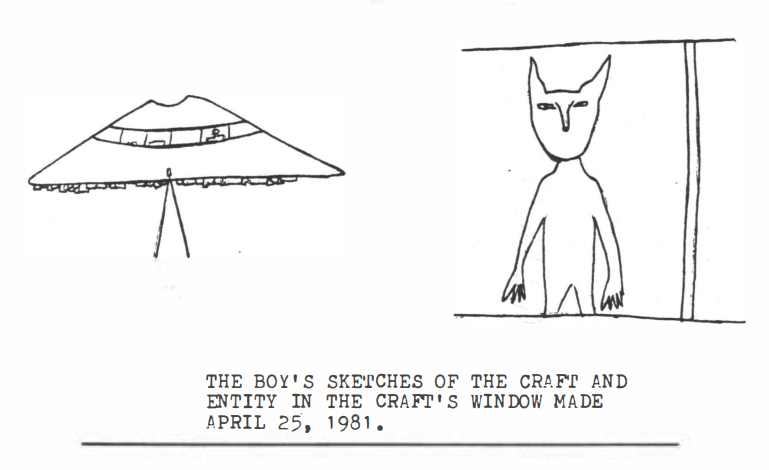
The included transcript contains highlights of the session when the boy was told to focus on the voices. When asked what he thinks they’re saying to him, he says, “I won’t be harmed. They’re just going to examine me.” When asked if he can see anything associated with the voices, he describes a “person” with a big head and a small body “floating across the window of the ship.” He says “the eyes are big, the nose is long. I don’t think it has a mouth.” Asked how it was dressed he says, “It’s not, it’s just there. It’s his body.” At the end of the session, the boy says he was told that they’d see him again, but he didn’t know when. A picture of the “person” he drew just after the session is included.
According to the investigators, on February 12, 1981, “the other shoe dropped.” Having been “avid readers of UFO literature,” they had been wondering why there had been no “aftereffects that many times are manifest following close encounters.” Then, the mother “obviously upset,” told them that she and her husband had been keeping information from them because they didn’t want to complicate the case. The stepfather then wrote a chronology of strange events, and it is included.
According to the chronology, which covers February 2-10, footsteps were heard by the family where no one was thought to have been, water was found inside closed containers and on the bodies of the mother and father when they were in bed, and objects went missing and were found where they weren’t expected to be. One example is the keys of the Scoutmaster going missing and then being found in the ignition of his truck where he had already looked.
A witness statement from the Scoutmaster is included, and according to him, the boy told him that lights and faucets had been turning on and off by themselves. The Scoutmaster then witnessed this for himself. Then, when the boy said that doors had been swinging by themselves, the Scoutmaster challenged whatever entity might have been responsible to move a door that instant, and he saw the boy’s bedroom door swing in a two-and-a-half-foot arc.
The third and last part of the report (page 13 of the pdf) appears in the January 1982 Newsletter. After a good deal of analysis and discussion, the investigators conclude that it was unlikely that the family had colluded in deceiving them: “Once again, there was no motive; in fact, because of the personal problems the family was experiencing, a hoax might have had very negative consequences.”
According to the investigators, the boy was tested by a certified school psychologist and there was no indication of “severe emotional disturbances.” The report ends with this: “The possibility of a mild seizure disorder was suggested (petit mal), a condition found present also in a small tested sample of suspected poltergeist agents. 5” The footnote (in the original) refers to “Roll, The Poltergeist, Signet Paperback, Chapter 13, New York, 1972.”