by UFO History Buff & Author, Charles Lear
 Starting in December 1975 and continuing into the middle of 1976, there was a UFO flap in the area of Madoc, a village in Ontario, Canada, halfway between Toronto and Ottawa. Investigators from the Ontario-based Neptune Research Organization went to the area, interviewed witnesses, and were able to see for themselves what may be the most unique UFO-related trace evidence ever recorded.
Harry Tokarz, “affiliated with Neptune Research” and “editor and publisher” of UFO Pulse Analyzer wrote a report on the case and published it in the first issue of his journal, put out in April 1977. According to Tokarz, the flap came to the attention of the press when a farmer in an area north of Madoc found something unusual on his property and contacted Madoc Review reporter Ron Heiser. NRO found out about it and seven investigators, including Tokarz, “were dispatched.” Besides studying and analyzing what was in the farmer’s field, they found several witnesses who reported seeing UFOs throughout the Madoc area.
The earliest report described is that of Pauline Dudgeon who said that on December 11, 1975, a bright light caught her attention. She went to a window, looked out, and saw a large object that took up the width of Highway 12. A pulsing red light on top of it made her think she was looking at a traffic accident scene. She went outside and was, in Tokarz’s words, “awed by what she described (from 1000 ft. distance) as a disc or oval-shaped object with a dome or cupula on top and bright lights revolving around its periphery.” She was particularly fascinated by the bright light on top as she watched the object for 20 minutes.
After Dudgeon went back inside, she still had a residual image of the light. Her vision was blurred, and she found herself continually blinking and wiping her eyes. An eye specialist in Belleville told her she was suffering from what would result if one was to stare at a welding arc without safety goggles. Tokarz notes that eyes being affected by ultraviolet radiation during close encounters with UFOs is a common occurrence and cautions against prolonged observation of “brilliant” objects.
According to Tokarz, “exactly three weeks later,” the Dudgeon family saw a similar object hovering in a field near their home. Doug Dudgeon reported that it left at “fantastic speed” over their barn. There were multiple witnesses, including Mr. and Mrs. Frank Pringle. “Four beam-like projections” reportedly came from the flat underside of the object and Tokarz speculates that this might “tie in” with “the 200 or more 18” growth circles found on the Barry farm.” There is no account of that aspect of the case, but on page 9 there is a drawing detailing the circles.
Most of the sightings described took place in the first two weeks of June 1976. According to Tokarz, Bill Holmes and his family claimed to have had five sightings of, in Tokarz’s words, “large illuminated objects” during the period from June 4-13, 1976. Only the first sighting near the family home is described and is said to be of an object at treetop height that was too bright for any details to be discerned. Mr. Holmes said it was top-shaped and that as it hovered, “all animal sounds abruptly ceased and the air was still.” It then seemed to land in a nearby field where large areas of scorched barley were later found that hadn’t been there previously.
The last sighting described was reported by Dennis Craigen of Neuburgh, Ontario. According to the account, Craigen said that on June 12, 1976, while driving towards his house with his girlfriend, he saw a total of four lights. He spotted the first one as it descended behind some trees next to the road in front of him, but he didn’t see it as he drove by.
Then, as he came up to his house, a second light appeared out of nowhere and flew towards the car. It suddenly reversed direction, flew over the house, and hovered. It was joined by another object that, in Craigen’s words, “turned on like a light bulb.”
The couple watched for a few minutes and then Craigen turned the car around and headed for the Ontario Provincial Police detachment in Neuburgh. On the way, he saw a fourth light that was going about 50 mph at an altitude of 200 feet. He described the lights as red spheres that were able to change direction quickly in a single movement. He said they got brighter as they rose up silently at 30-60 mph and would “feather out” as they descended.
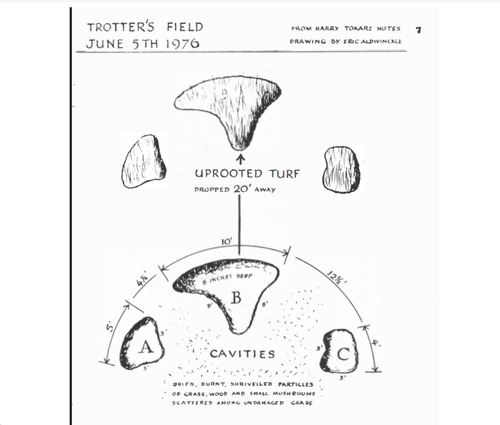
Using our license to do so, we’ve saved the most dramatic report for last, although it’s the first one detailed in Tokarz’s report. According to Tokarz, on May 12, 1976, in a remote area north of Madoc known as “the island,” Cooper, Ontario, farmer Reginald Trotter was hauling wood when he noticed three large eight-inch deep holes in his field. What was unusual was that the removed dirt was sitting near the holes with grass still on top like large chunks of sod.
A drawing made by Eric Aldwinkle from Tokarz’s notes is presented on page 7 and is titled, “Trotter’s Field June 5th 1976.” It shows three “cavities” marked A, B, and C. A and B are triangular with the sides of A measuring 3’x3’x5’, and the sides of B measuring 8’x8’x10’. C is more of a rectangle but is treated as a triangle with measurements of 3’x3’x4’. Just above the cavities is the “uprooted turf dropped 20’ away.” The longer measurements appear to be part of an arc totaling 36’.
According to Tokarz, Trotter made a phone call to the Canadian Forces Base in Trenton, Ontario, and it was then relayed to the OPP in Belleville and finally to the OPP in Madoc. Lightning was suggested as the cause, but this was ruled out by “lightning expert for the government,” Dr. Frank C. Creed. Trotter knew himself that lightning leaves furrows and scorch marks, and these were not present.
Other experts weighed in: the head of a construction machinery manufacturing company, Bob Reinke, said, “no conventional farm or earth moving machinery could have moved these pieces intact, which weighed between 400-800 pounds apiece;” and geologist, Dr, John Westgate, in Tokarz’s words, “could offer no plausible explanation for this anomaly.”
Tokarz notes that there is no evidence that a UFO “touched down” and speculates that one “made a close approach,” sucked up the chunks of earth, and dropped them as it flew on. He tells the reader that in 30 years of investigation, there had never been a similar case.
Bob Pratt wrote an article (page 61 of the pdf) about the case headlined, “UFOs Sighted in Area Where Huge Chunks of Earth Are Mysteriously Cut From Ground and Moved Intact,” published in the August 17, 1976, National Enquirer. Apparently, Tokarz and the other investigators didn’t talk to enough farmers in the area. Pratt wrote that similar holes where “the earth and grass were moved intact” were found on two other farms in the area. Farmer Glenn Rollins is quoted: “One of the pieces I found must have weighed at least 600 pounds – and it was 30 feet from the hole. There were no signs of machinery or tracks.” Trotter also ruled out machinery being used on his property saying, “Any vehicle would have to go right through my yard.”
Mysterious diggings found in fields in Pine Bush, New York, with the removed dirt missing were reported during a period of extensive UFO and high-strangeness activity that started in the 1980s and continued into the ‘90s. Ellen Crystall wrote in her 1991 book, Silent Invasion (Chapter 9, page 87), “Occasionally, some of the local residents found diggings on their property – diggings large enough to have been made by machinery – but where no construction had been authorized by the owners.” She explains that the land is owned by farmers and that while some “ground markings” were present, “it was as if whatever occurred at night was removed or camouflaged against curious people like us.”