by UFO History Buff & Author, Charles Lear
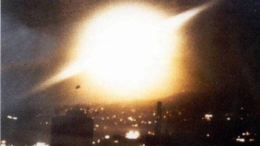 In last week’s blog, we looked at a case from the Canary Islands involving thousands of people reporting that at around 10:30 p.m. on June 22, 1976, they saw a huge sphere of light in the western sky. The Spanish Air Force investigated, and included in the case file (released on July 22, 1994) are testimonies from members of the crew of the Atrevida, a Spanish Navy corvette, and Dr. Francisco Julio Padrón. The captain of the Atrevida said that a “luminous point of intense bluish-yellow” came up from the ground and reached an altitude of 15-18 degrees where it stayed for about two minutes while “generating a large halo of intense bluish-yellow light that persisted in the same position for forty minutes.” This matches almost all of the other reports. Padrón, on the other hand, said that while in a taxi on his way to see a patient in the town of Gáldar, he saw a transparent sphere 60 yards away that had two red humanoids inside. Even though Padrón’s description was unique and dismissed by the Air Force investigator, many accounts of the case focus on it, from the first reports in the press up until the present day. The cause of the sightings remained a mystery until two Spanish investigators, Vincente-Juan Ballester Olmos and Ricardo Campo Pérez, looked into the case and came up with a likely explanation.
Campo wrote the article headlined “Dos Gigantes Rojos Cabalgando un Misil” (Two Red Giants Riding a Missile) that was posted on June 22, 2016 (the 40th anniversary of the sightings), on the Naukas website. In it, he is highly critical of the press and others who promoted Padrón’s story to the extent that what was seen by people all over the Canary Islands became known as the “Gáldar UFO.”
According to Campo, the Air Force investigator, Commander Antonio Munaiz Ferro-Sastree (incorrectly identified as “Juez” in last week’s blog) wasn’t the only one to dismiss Padrón’s story. One person he mentions is Manuel Borraz, who after analyzing data and testimony, published his findings in a 1990 paper titled “Los Gigantes De Gáldar y Los Avistamientos Canarios (The Giants of Gáldar and the Canarian Sightings). Campo quotes from it: “Everything suggests that this witness’s mind played a trick on him, distorting what he, like thousands of other Canary Islanders, had the opportunity to observe, and which was taking place more than 700 kilometers west of the archipelago.”
Another person Campos quotes is a “fan of parapsychology,” Dr. Alejandros Carlos de Gyorko-Gyorkos: “I couldn’t find anything to support the witness’s testimony.”
According to Campo, Padrón continued giving statements over the years that became “increasingly extravagant.” In 1972, Padrón told a reporter from Diario de Los Palmas that he experienced “great clairvoyance” during his sighting, and in 1994, upon the release of the Air Force file, he told the paper this: “The beings on the ship have the ability to erase your mind, everything that happens. And you’ll see inside your mind for months, maybe a year, what they want you to do. They replace an energy in your brain. That’s the problem.”
Campo says he went the area of Los Rosas two weeks before and spoke with one of the children of the patient Padrón was going to visit who told him that Padrón continued to visit the site for many years hoping to see the “ship” and that at one point, while driving in the area, he slipped into a ravine and needed help getting the car out.
Campo also brings up an incident reported in the June 26, 1976, La Provincia that helped to perpetuate Padrón’s story. An onion farmer near Gáldar, José Gil González, said that when he went to water his field on June 24th, he found a circular area that was damaged. According to Campo, Gyorko-Gyorkos collected samples and told La Provincia, which published his statements on the 28th, that he had found nothing out of the ordinary.
Campo presents the only known photo, in color, of what was seen on the 22nd, and says it was taken by a tourist in a hotel on Grand Canary Island who left it at the reception desk. There is a copy of it, black and white, in the Air Force file. Two arms of light are seen extending out of a huge sphere of light, and Campo explains that these are caused by the camera lens.
A black and white copy of the photo, possibly from the Air Force file, appears on the cover of the Vol. 29, No. 4, July 2005 International UFO Reporter put out by the Center for UFO Studies. On page 3 of that issue there is a translation of the article by Ballester and Campos originally published as “Identificados: Los OVNIS de Canarias fueron misiles Poseidon” in the official journal of the Spanish Air Force, Revista de Aeronáutica y Astronáutica, in March 2001.
The IUR article is headlined “Navy Missile Tests and the Canary Islands UFOs.” As the headline indicates, Ballester and Campo came to the conclusion that what was seen on June 22nd, as well as on other occasions from 1974 to 1979, were the result of missile tests. They acknowledge that they weren’t the first ones to consider this and refer to the work of others, including Manuel Borraz, who believed that, according to his calculations, “the missiles responsible for the Canary sightings were launched from submarines sailing between 700 and 1,600 kilometers west of Tenerife Island.”
Ballester and Campo describe their investigation to determine which country was responsible. According to them, Ballester sent a report detailing five incidents to former NASA employee James Oberg, a UFO skeptic who wrote on the subject, and Oberg replied saying “I have found a definite correlation with Poseidon missile launchings.” According to the authors, Oberg included “a table prepared by Gunter Krebs providing data about Poseidon missile launches matching Canary UFO cases.” Krebs had consulted a database prepared by astrophysicist Jonathan McDowell of the Harvard-Smithsonian Center for Astrophysics, who in turn used data from Eastern Rocket Launches 1950-1994 by historian Mark C. Cleary.
Ballester and Campo present the table with data for the five incidents and explain the “meaning of each column.” With this information it can be seen that there were two Poseidon missiles launched on June 22, 1976, from the USS Von Steuben (SSBN-632), one at 2016 GMT and the other at 2017 GMT. The authors note that there is a one-hour difference in the recorded launch times and the sightings that were reported to have begun at 2115 GMT. They explain that they consulted with Cleary and “he informed us that he had also detected several errors in times and dates in some launchings, after comparison with data from his own Range Scheduling Department.”