by UFO History Buff & Author, Charles Lear
 “In mid-January 1975, for about three minutes, a spaceship landed on a hill in New Jersey, apparently to collect soil samples. It happened again last month.” This is according to Budd Hopkins in the summation of his article about a case he looked into published in the March 1, 1976, Village Voice under the headline “Sane Citizen Sees UFO in New Jersey.” At the time, Hopkins was a Manhattan-based artist who was just getting started as a UFOlogist. According to him, he contacted veteran saucerologist/UFOlogist Ted Bloecher for advice who then joined the investigation. Bloecher was then the director of the New York State chapter of the Mutual UFO Network. Another veteran, James W. Mosely, a practitioner of what he called “middle UFOlogy,” also investigated on his own. Bloecher wrote a report (page 3 of the pdf) for the MUFON publication, Skylook, and Mosely covered it in his “Non-Scheduled Newsletter,” Saucer News. Hopkins also covered the case in the second chapter of his 1981 book, Missing Time which brought it to a wide audience.
Hopkins begins the article describing a “tall round apartment building” named Stonehenge that sits on top of the Palisades. He notes the coincidence of a building with that name sitting “a few hundred yards” from the site of “a startling event.”
The man who reported the incident was 72-year-old New Jersey resident and Manhattan liquor store owner (a “teetotaler” according to Hopkins) George O’Barski. Hopkins tells the reader that O’Barski and his business partner had been his friends, “my evening check cashing service, and the source of my dinner wine for 17 years.”
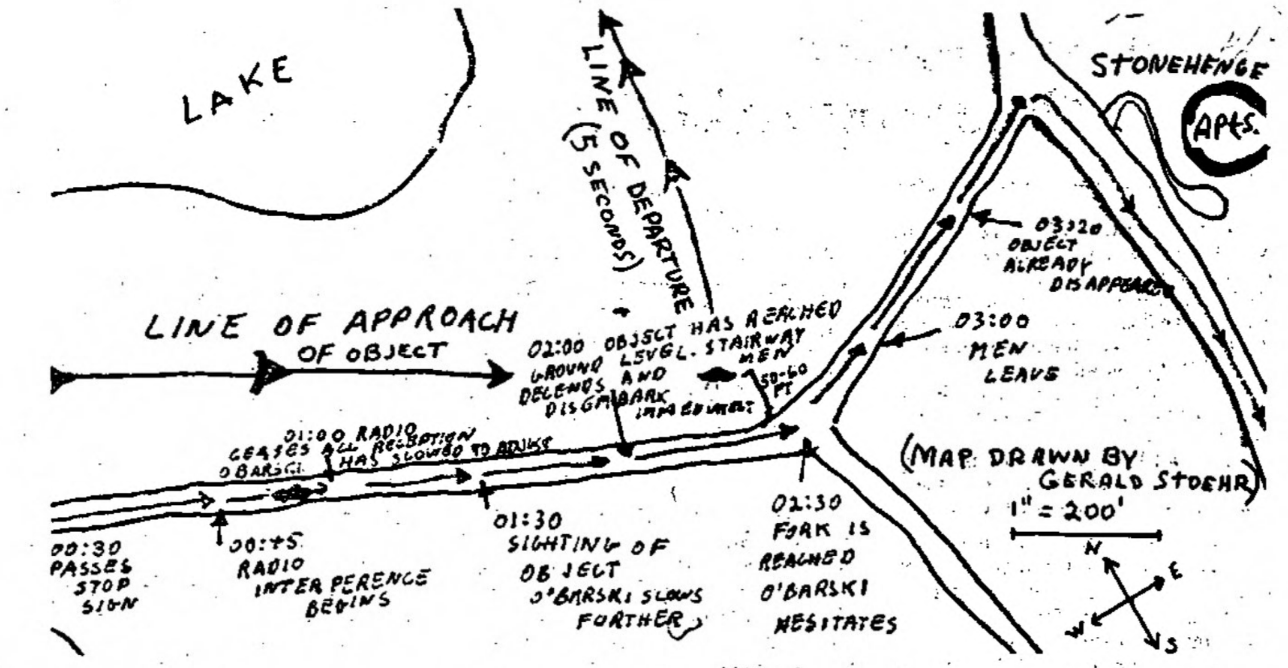 According to Hopkins, after closing up, O’Barski was driving through North Hudson Park at 2 a.m. on his way to a restaurant in Fort Lee. He started hearing static coming over his radio, and as he slowed down to adjust it, it faded out, and he heard a noise like the hum of a refrigerator on his left. Then, he saw a large, bright object traveling parallel to him behind a row of trees. It came to a stop seconds later and hovered ten feet above the ground.
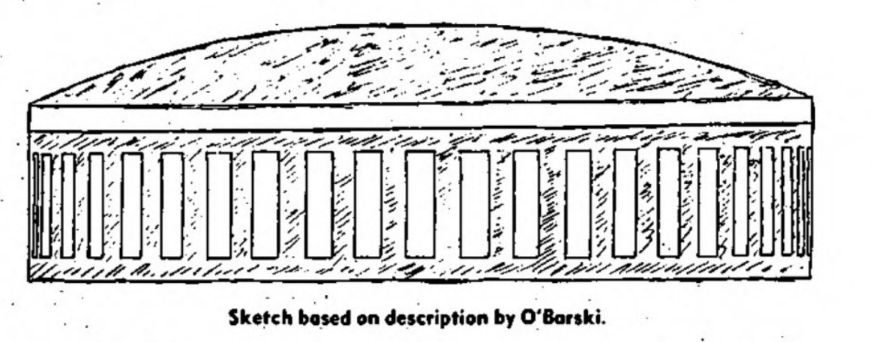
O’Barski described the object as 30 feet in diameter and 8 feet high. He said it was flat on the bottom, had vertical sides, a domed top, and rectangular lit-up windows all around it that were 1 ½ feet wide and evenly spaced
According to him, a staircase came down, a door opened vertically, and 9-11 creatures about 3 ½ feet tall descended the stairs. O’Barski described this: “They came down this ladder thing like kids coming down a fire escape. Fast. No wasted motion.” They were all wearing light-colored coveralls (looking “like kids in snowsuits”) and helmets that obscured their faces. They each had a spoon-like shovel and a small bag with a handle, and they immediately got to work digging into the ground and scooping dirt into the bags. After a “few moments” of this, they went back up into the craft, it rose up, and took off to the north. The entire episode took less than four minutes.
O’Barski was frightened and went home. He tried to sleep, got up, and took two aspirin. He said, “I didn’t know what to think. I thought either I’m going crazy or there’s something awfully wrong down there.” The next day he went to the park and saw about 15 holes 5-6 inches deep, which scared him. He had trouble believing they were actually there, and he put his hand in one of them.
According to Hopkins, O’Barski told him the story in November. After reaching out to Bloecher, Hopkins, Bloecher, and another MUFON investigator, Jerry Stroehrer, went to the site with O’Barski on November 23rd. There, they saw about 15 small circles that had no grass or roots, and they later found a park worker who said he had filled in a bunch of small holes in the early summer that he assumed were made by dogs.
Hopkins went to the Stonehenge building, which had a 24-hour doorman, asked questions, and found out that in the early morning hours in January “a huge front plate glass window in the lobby had been shattered under rather unclear circumstances.” He was given the name of the night doorman, Bill Pawlowski, who had been working in January and had since moved on.
Hopkins found Pawlowski, told him he was looking into an incident involving unusual lights in the park, and Pawlowski said he had seen 10-15 bright lights evenly spaced in a horizontal row that appeared to be 10 feet above the ground. According to him, he could also make out a dark mass surrounding the illuminated row. He turned away to make a phone call, and “heard a high-pitched vibration and a sudden crack.” When he looked back towards the park, the lights had gone. He called the police, two officers responded, and when they and Pawlowski examined the window, they saw it had been cracked by something that came from above that did not go through. No projectile was found.
Pawlowski told police lieutenant Al Del Gaudio, a resident who was returning from duty at 6:30 a.m., what he witnessed, and Hopkins spoke with Del Gaudio who confirmed this, but said “He must’ve been drinking or something.”
As Hopkins and the others were about to close the investigation, two witnesses who weren’t aware of O’Barski’s sighting said they had seen a UFO land in the same spot on January 15, 1976. Hopkins tells the reader that details of this report are being withheld until corroborating witnesses can be found.
Bloecher’s account in Skylook is a more detailed version of Hopkins’s story except that in his version, the uniforms of the creatures are said to have been dark. He also includes witness accounts from three Stonehenge employees: two who said they saw lights in the park in January of 1975, and one who said he saw a localized fog that would appear in the park both day and night.
Mosely’s account is also similar to Hopkins’s except that he reports the craft as being egg shaped. According to him, he interviewed O’Barski and considered him to be “sincere.” He notes that O’Barki’s memory of the event “brings fear to his heart.” Mosely adds this observation that supports Bloecher’s account: “Your editor’s research reveals that almost all the staff of Stonehenge have made unusual sightings recently, at one time or another, as well as at least a few of the tenants.”
Mosely then presents details of something strange witnessed by the night staff on three nights in February “being published here for the very first time.” According to him, one of the witnesses described seeing a five-foot figure in the park late at night. The figure was wearing a helmet with a light on it, avoided streetlights, walked like a robot, and constantly bent to the ground in an awkward manner as if it was picking something up.
According to Mosely, local papers “had been full of saucer sightings from the same area.” He says, “The culmination of this flap was a ‘media event’ which turned out to be a dreadful fiasco, and for which we received (in our own opinion, at least) an unfair share of the blame.”
Timothy Green Beckley and Harold Salkin, longtime acquaintances of Mosely’s, called him in March to tell him that Chicago radio personality Warren Frieberg and his “trance-medium” wife, Libby, were coming to New York. Since Mosely lived in Fort Lee, Beckley and Salkin asked if the Friebergs could hold a press conference in his apartment followed by an attempt “to communicate psychically with space beings” in the park.
Unfortunately, the press released the time and location prior to the event, and the Friebergs, along with Mosely and company, were met at the park by a huge crowd that consisted mostly of teenagers out on a Saturday night. The Friebergs braved the crowd, and Mosely and the others formed a circle around them and chanted “Alpha, Omega” at their request. The crowd started chanting “‘Frisbe, frisbe’ and other unharmonious phrases.”
The crowd closed in until someone spotted “a midget or a child in a tinfoil outfit, carrying a flare.” The crowd ran towards the figure, and Mosely and company ran in the opposite direction towards the Stonehenge. The Friebergs got into their car, and when the crowd lost sight of the “spaceman,” people came over to the car and started rocking it and pounding on it.
The Friebergs managed to escape, held a “rather pathetic séance” on the roof of the Stonehenge, and spoke with Colderin of the Grapalins who were “here to encourage us to save our environment.”
Warren Frieberg went on the Long John Nebel show a few days later and said that they were in town only because Mosely had invited them. Mosely assures the reader that “we had nothing to do with the media publicity before or after the event!”