On a bright sunny afternoon in 2007 on the east coast of Australia I saw in the sky above me what I thought was a white balloon. Then I realized it was approaching high from over the ocean and would stop and then move again. I don’t know how big it was or how high, but I got the impression their was a lot of sky between me and it. Then I noticed there were more ‘white balloons’ with it in a loose formation. As you are aware the brain attempts to reconcile/process from known experience what it is looking at; for me it was firstly a balloon, then possibly a fighter jet in a vertical climb – but none of these made sense, or were realistic. I reported/recorded it online with a local UFO site and described as -bright stars on a sunny day. The UFO site got back to me with a vid link of ‘flotillas’ (which I not aware of previously) and my viewing was (I think) a flotilla. Intrigues me still. Regards
Author: admin
The Aguadilla UFO
by Charles Lear
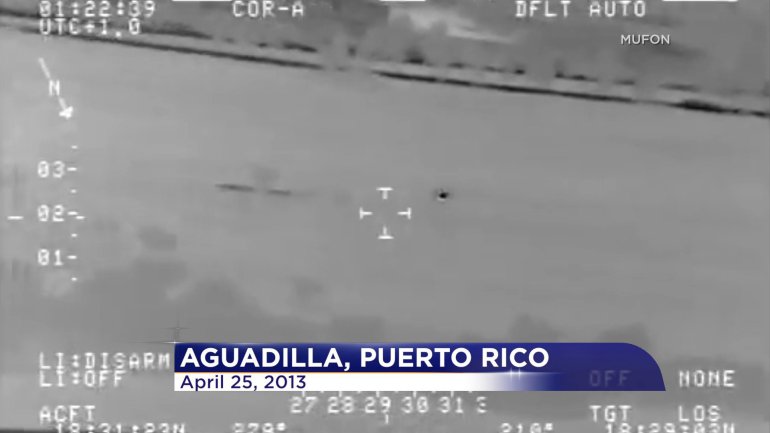 Because of all the media coverage regarding the Pentagon UFO videos, an extraordinary video reportedly captured by Department of Homeland Security personnel has fallen into the background. It has become known as the “Aguadilla” video and the identity of the object caught on video remains a mystery.
The case was investigated by the Scientific Coalition for UFOlogy (now the Scientific Coalition for UAP Studies) and a report was written that is available on the group’s website. According to the report, at around 9:30 p.m. on April 25, 2013, the departure of a commercial aircraft was delayed due to an unknown object flying at low altitude across the runway at Rafael Hernandez Airport in Aquadilla, Puerto Rico. In the area at the time was an airborne U.S. Customs and Border Patrol aircraft and the crew managed to capture infrared video of the object
The SCU investigators describe having obtained a copy of the video from an official source who insisted on remaining anonymous. The authors state that the individual’s identity, background, and employment were all verified and that “extensive efforts were made to ensure that this video did not contain any classified information.” Read more

1968 Metuchen Daylight UFO Encounter
(Full Witness Rendition Image Below)
I had a daylight viewing of low oval metallic object gliding toward a
second identical object, pausing then simultaneously shooting
skyward.
July 1968 Sunday evening. I was 13 years old at the time. I went to
fill the bathtub and get ready for summer school the next morning.
While filling the tub, I went to close the window shade. This was
about 6:30 -7:00 in the evening and was still daylight outside. As I
looked out the window my attention was drawn to a metallic looking
oval object in the distance, moving very slowly along from my left
field of view toward the right. From my location on Maple Avenue in
Metuchen, I could see this object was gliding slowly above the train
tracks, power lines and tree line that ran parallel to what was then
the Pearl Street parking lot. There is now a high rise condo/apartment
complex there, next to the train tracks.
I called for my mother who was downstairs to come and look. At the
same time another identical object appeared on the right, moving
slowly left toward the other object. They both glided slowly and came
to a stop in front of one another, paused for a moment, then
simultaneously shot straight up at such a speed that only streaks of
light were visible – similar to the “hyperspace! ” effect now seen
on Star Trek. Both oval metallic looking objects had no other features
that I could see, and I had a clear view. My mother did not arrive in
time to see what I was shouting about. Read more
Show #459 Notes: Matthew Roberts & Kevin Knuth, Ph.D
Simulcast on KGRA Radio, YouTube, and Facebook
Tuesday, June 15th, 6:00-8:00 PM EDT (-4GMT)
In 2015, Matthew Roberts was a US naval service member stationed onboard the USS Theodore Roosevelt. The events that transpired during their 2015 workup cycle brought us the first-ever declassified footage of unidentified aerial phenomenon (UAP) and the New York Times article titled: “Glowing Auras and ‘Black Money’: the Pentagon’s Mysterious U.F.O. Program.”
Subsequently, he transferred to the Office of Naval Intelligence in Washington D.C. where he began to have frequent, and often intense, personal experiences with the phenomenon. He discovered through a long, painful, and terrifying journey that the truth of the phenomenon has deep and profound implications for the future of the human race. It may seem like a bold statement but the ultimate universal truth that underlies the phenomenon is captured in the simple yet eloquent words of Mark Twain, “The two most important days in your life are the day you are born, and the day you find out why.”
The views and opinions expressed herein by the author do not represent the policies or positions of the United States department of defense or the United States navy and are the sole responsibility of the author
Prof. Knuth is an Associate Professor in the Department of Physics at the University at Albany (SUNY), and is the Editor-in-Chief of the journal Entropy (MDPI). He is a former NASA research scientist having worked for four years at NASA Ames Research Center in the Intelligent Systems Division designing artificial intelligence algorithms for astrophysical data analysis. He has over 20 years of experience in applying Bayesian and maximum entropy methods to the design of machine learning algorithms for data analysis applied to the physical sciences. His current research interests include the foundations of physics, quantum information, inference and inquiry, autonomous robotics, and the search for and characterization of extrasolar planets. He has published over 90 peer-reviewed publications and has been invited to give over 80 presentations in 14 countries.
http://knuthlab.rit.albany.edu/
UFOs Over Indonesia
Charles Lear
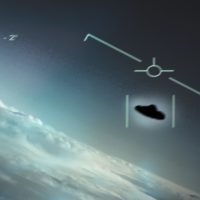 Wherever there are UFOs, there are UFO enthusiasts, and since there are UFOs everywhere, UFO enthusiasts can be found everywhere as well. This week we’ll look at Indonesia, where members of that region’s largest UFO organization have recently offered their opinion to the local press on the upcoming Pentagon UAP Task Force unclassified report due to come out later this month.
An article written by Wulan Kusuma Wardhani and posted online for The Jakarta Post on Monday, June 7, 2021, is headlined, “Not a cult: Indonesia’s biggest UFO-community BETA-UFO weighs in on U.S. government report.” The two people speaking for the organization are 55-year-old Nur Agustinas and 48-year-old Anugerah Sentot Sudono. Agustinus was a cofounder of BETA-UFO IN 1997 along with Bayu Yunantias Amus and several others, and Sudono is described as a “senior member” in the article.
BETA is an acronym for “Benda Terbang Aneh,” which is Indonesian for “Unidentified Flying Object.” The term was introduced in the 1960s by Jacob Salutan, founder of the Indonesian National Institute of Aeronautics and Space. Salutan was a vice air marshal in the Indonesian Air Force and started Studi UFO Indonesia (Indonesian UFO Studies/SUFOI). He wrote two books on UFOs: “UFO: Salah Satu Masalah Dunia Masa Kini” (UFO: One of the Current World Problems) and “Menyingkap Rahasia Piring Terbang” (Unveiling the Secrets of UFOs). As of this writing, SUFOI appears to be inactive.
Show #458 Notes: Caz Clarke
Simulcast on KGRA Radio, YouTube, Facebook & Twitch – Tuesday, June 8th, 6:00-8:00 PM EDT (-4GMT)
BIO: Since the covid outbreak, Caz has become a home maker. She is 57 years old and was not a believer in UFO’s.
Since the incident in February 2016 and the subsequent threats Caz has received her life has changed considerably. It has now become her mission to prove the truth and to open the door to disclosure in the UK.
Click “Read More” for images
R.I.P. Mr. UFO
By Charles Lear
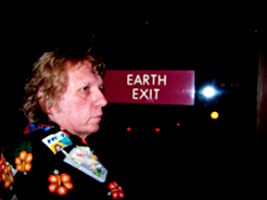 This past Memorial Day, May 31, 2021, UFO and paranormal researcher Timothy Green Beckley passed on. He was a colorful character who stood out in a field full of colorful characters, and while he might not have been the most serious of researchers, he was part of a circle of legendary characters from the days of flying saucers that included James Moseley, Gray Barker, and John Keel.
Records of Beckley’s age at the time of his passing range from 65 to 69. According to the IMDb, he was born on March 4, 1952 as Jeremy Stone. In addition to his interest in the paranormal, he was an actor in and producer of soft-core porn/horror movies and was known to fans as “Mr. Creepo.” He wrote and published many books on the paranormal with a definite sensationalized bent and was active in the community up until his death. According to what is believed to be his self-authored bio, “Tim Beckley had so many careers that even his own girlfriend didn’t know what he did for a living… Timothy Green Beckley has been described as the Hunter Thompson of UFOlogy by the editor of UFO magazine Nancy Birnes.” His bio contains the claims that his life was saved by an invisible force at the age of three, he started having out of body experiences at the age of six, he had his first UFO sighting at age ten, and had two more after that in the course of his life.
Show 457 Notes: Ron James
Simulcast on KGRA Radio, YouTube, Facebook & Twitch – Tuesday, June 1st, 6:00-8:00 PM EDT (-4GMT)
Bio: Ron James is a filmmaker, on-camera personality, writer, editor, researcher, content creator and entrepreneur. He has won 19 national awards, including 4 EBE awards, The Telly Award and the Aegis Award for Excellence in Broadcasting four times. He has created 7 feature length documentaries and dozens of original series episodes. He produced the Citizen Hearing on Disclosure with Stephen Bassett, numerous other conferences and hundreds of hours of other finished content in the ET field. James has also been involved at the highest levels of production for musical acts such as Guns & Roses, The Smashing Pumpkins, The Beach Boys, Earth Wind and Fire, Kendrick Lamar, and many more. He has created 150 studio-based DVDs covering specialized topics. He has made over 250 TV Commercials. He currently makes his own shows including “Bigger Questions”, “Spacetime”, “MUFON Presents” and more. He maintains his own state-of-the-art independent production studio in Los Angeles. James is also the co-founder of MUFON Television, an online TV channel boasting the world’s largest collection of commercial free UFO related material. www.MUFONTelevision.com #MUFONTelevision #RonJames #BiggerQuestions #SpaceTime
A UFO in Lumberton, North Carolina
by Charles Lear
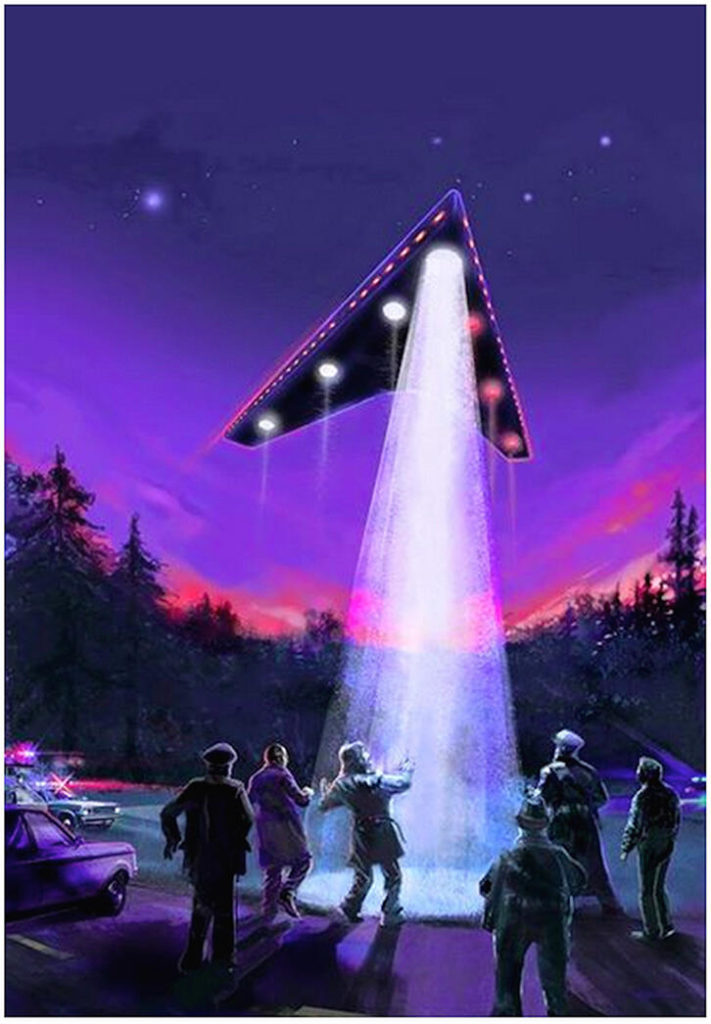
It is often the case with UFO investigators that once they get to an area where a UFO has been reported, the UFO is long gone, and all they can do is interview witnesses. This is important as a means of creating a record of the case that can be referred to by future investigators and researchers. But, occasionally an investigator gets the chance to be a witness and actually observe what had been reported. This happened to investigator Lee Speigel who was looking into a series of sightings by as many as thirty police officers and 50 civilians in Lumberton, North Carolina in 1975. Spiegel submitted a report on the case to the director of the Center for UFO Studies and former Project Blue Book scientific consultant, J. Allen Hynek. The case file resides in the archives housed by David Marler in New Mexico.
Along with Speigel’s report and contemporary newspaper clippings, there is also a series of paper slips in the file folder containing call information, presumably filled out at a CUFOS UFO call center. (If anyone can confirm this, please comment.) According to Speigel’s report, a violent thunderstorm in the area ended at 1:35 a.m. on April 3, 1975. A “call slip” in the case file has the information that at 1:45 a.m., Sheriff Ronn Thompson was monitoring the radio while working as the dispatcher at the Robeson County Sheriff’s Office in Lumberton when the first report of a strange object came in. It was seen by Robeson County Officer Phil Stanton and then by two officers from St. Paul. All three described the object as v-shaped with red, blue, and clear lights. A slip with 5:15 a.m., filled in for the time has the information that two Sampson County officers saw a similar object that put a spotlight on them as it moved off. One of the officers “clocked it” at 200 mph. It appears that there was a full fledge flap after 10:00 p.m. that night because a slip with 10:15-10:30 p.m. filled in for the time has information on the back that officers from four different police departments and 50 “citizens” reported seeing something.
Show 456 Notes: Jack Bushong & Ian Rogers
Simulcast on KGRA Radio, YouTube, Facebook & Twitch – Tuesday, May 25th, 6:00-8:00 PM EDT (-4GMT)
Dave Marler & Charles Lear at 56:15 in the above video. 104:30 is the Guardian, Carp, Ont. Case footage.
https://podcastufo.com/michigan-u-f-o-s-on-radar/
JACK BUSHONG knew since he was in 9th grade he would be a meteorologist and concentrated on studying advanced math and physics. By 1983, Jack was accepted to the Meteorology program at Florida State University in Tallahassee, FL. In August 1989, he began my career with the National Weather Service Office in Grand Rapids, MI and for the first time I enjoyed seeing summer turn into winter for the first time in 20 years. His job with the NWS in Grand Rapids was hourly surface observations and the issuance of Severe Weather Warnings and Statements as well as relaying the information on NOAA Weather Radio. By 1991, he requested a transfer to his hometown in Muskegon, MI and to also receive radar experience. When the UFO Event occurred in March 1994, Jack had 3 years weather radar experience. He had on the job training as well as a certification course then 2 complete classroom training courses at the NWS Training Center in Kanas City.
IAN ROGERS: is the author of the award-winning collection, Every House Is Haunted. A novelette from the collection, “The House on Ashley Avenue,” was a finalist for the Shirley Jackson Award, and is the basis for an upcoming Netflix film produced by Sam Raimi. Ian lives with his wife in Peterborough, Ontario. For more information, visit ianrogers.ca.
Stream UFO Town for free: https://www.cbc.ca/cbcdocspov/episodes/ufo-town
#ufotwitter #UFOtown #IanRogers #JackBushong #MichiganIncident #CarpOntario
A Helicopter Crew Encounters a UFO
by Charles Lear
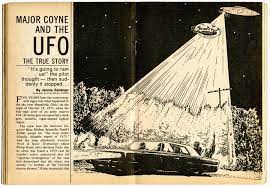 As one looks into UFO history, there are cases that turn up again and again in books, blogs, magazines, newspapers, and documentaries. These are the “classic cases” and they’re classics because they still intrigue those who come across them. A case known as the “Coyne Incident” is one of those, and it has all the elements that make a good case: multiple credible witnesses, an official report, extensive investigation, and contemporary news coverage.
According to the report, on October 18, 1973, four men with the U.S. Army Reserve took off from Port Columbus, Ohio, in a UH-1H helicopter at around 10:30 p.m. headed for Cleveland Hopkins airport. In command and at the controls in the right front seat was 36-year-old Capt. Lawrence J. Coyne. At the controls in the left front seat was 26-year-old 1st Lt. Arrigo Jezzi. Sitting behind them were 35-year-old Sergeant John Healey and 23-year-old Sergeant Robert Yanacsek. They were flying at an altitude of 2500 feet above sea level, 1300 feet above the ground over farmland with an elevation of 1200 feet. It was a clear night lit by a quarter moon.
At around 11:00 p.m., they were over Charles Mill Lake near Mansfield, Ohio, when Healy spotted a red light to the west moving south. Shortly thereafter, Yanacsek spotted a red light on the southeast horizon that he thought might be a tower beacon or airplane wing light. Then the light turned and moved rapidly towards the helicopter.
Worried about an impact, Coyne made a powered descent of 500 feet per minute and radioed the National Guard tower in Mansfield to find out if they had an aircraft in the area. After getting an initial response, radio contact was lost.
Show #455 Notes: Ralph Blumenthal & Damien Nott
Simulcast on KGRA Radio, YouTube, Facebook & Twitch – Tuesday, May 18th, 6:00-8:00 PM EDT (-4GMT)
Book: https://www.amazon.com/Believer-Alien-Encounters-Science-Passion/dp/0826362311
RALPH BLUMENTHAL
a Distinguished Lecturer at Baruch College of the City University of New York, was an award-winning reporter for The New York Times from 1964 to 2009, and has written and co-authored seven books on organized crime and cultural history. He co-authored the recent series of groundbreaking Times articles on the secret Pentagon program to investigate UFOs. He led the Times metro team that won the Pulitzer Prize for breaking news coverage of the 1993 truck-bombing of the World Trade Center. In 2001, Blumenthal was named a Fellow of the John Simon Guggenheim Memorial Foundation to research the progressive career and penal reforms of Warden Lewis E. Lawes, “the man who made Sing Sing sing.” The book on Warden Lawes, “Miracle at Sing Sing,” was published by St. Martin’s in June, 2004. His most recent book is “The Believer: Alien Encounters, Hard Science, and the Passion of John Mack,” published by High Road Books of the University of New Mexico Press. Read more
DAMIEN NOTT
was born in Sydney, Australia and grew up in the western suburbs of Sydney where he currently resides. His story came to public attention in 2012, after contacting a UFO research organization in an attempt to find an answer to his repeated experiences with the UFO phenomena. He became and continues to be an avid researcher focusing on that subject. He has appeared in episodes of Ancient Aliens, the documentary “Beyond the Spectrum”, and Produced and Directed “Australien Skies”. Two new films, “Haunted Skies” and “Fractured Realities” will be out this Spring/Summer!
UFOs, Science and Controversy at the University of Colorado
by Charles Lear
For a brief period in the late 1960’s, UFO enthusiasts were encouraged by the fact that some scientists were beginning to take the subject seriously. This was due in large part to renowned atmospheric physicist Dr. James McDonald’s coming forward and publicly acknowledging that he was investigating the mystery. Around the same time, in 1966, Project Blue Book scientific consultant Dr. J. Allen Hynek angered many in the state of Michigan by offering the possibility that some of the UFOs reported during a flap that year in the state were swamp gas. This lead to a congressional hearing looking into the Air Force’s handling of the UFO problem, and that resulted in an Air Force funded scientific study at the University of Colorado headed by physicist Dr. Edward U. Condon. This was something many in the UFO community had been hoping for, and they were optimistic that something positive might come of it. Unfortunately, the project ran into personality problems that nearly derailed it.
An article written by John G. Fuller and published in the May 14, 1968, issue of Look Magazine looks deeply into the matter. Under the headline “Flying Saucer Fiasco,” the article is introduced as “The extraordinary story of the half-million-dollar ‘trick’ to make Americans believe the Condon committee was conducting an objective investigation.”
After giving an overview of the project and its participants, Fuller references a story published early October 1966, in the Denver Post. Project Coordinator Robert J. Low, describing the UFO project as a function of the university, was quoted as saying that it “comes pretty close to the criteria of non acceptability.” Read more
Show #454 Notes: Luis Elizondo
Simulcast on KGRA Radio, YouTube, Facebook & Twitch – Tuesday, May 11th, 6:00-8:00 PM EDT (-4GMT)
https://luiselizondo-official.com
Break: “Rendlesham” by Johnny Cobb & Jerry McCoy
LUIS “LUE” ELIZONDO BIO: Former Senior Intelligence Official, Disclosure Advocate, National Security Expert, Former Director of the Pentagon’s UFO/UAP Program (AATIP)
Career Intelligence Officer with:
The United States Army
The United States Department of Defense
The United States Office of National Counterintelligence Executive
The United States Office of the Director of National Intelligence
∴ Program Manager/Director for AATIP (Advanced Aerospace Threat Identification Program)
∴ Senior Intelligence Operations Officer
∴ National/Strategic Policy & Strategy Development
∴ Foreign & Domestic Intelligence and Information Sharing
∴ Intelligence/Law Enforcement Integration
∴ Supervised & conducted espionage and terrorism investigations around the globe
∴ Managed clandestine source operations throughout the Middle East & Latin America
The UFO World Since December 16, 2017
By Martin Willis
Since our blogger, Charles Lear is off the week, I thought I would inject a brief opinion about my thoughts on what has changed with UFOs since late 2017. What better time to do that than now with my guest, Lue Elizondo who played a key role.
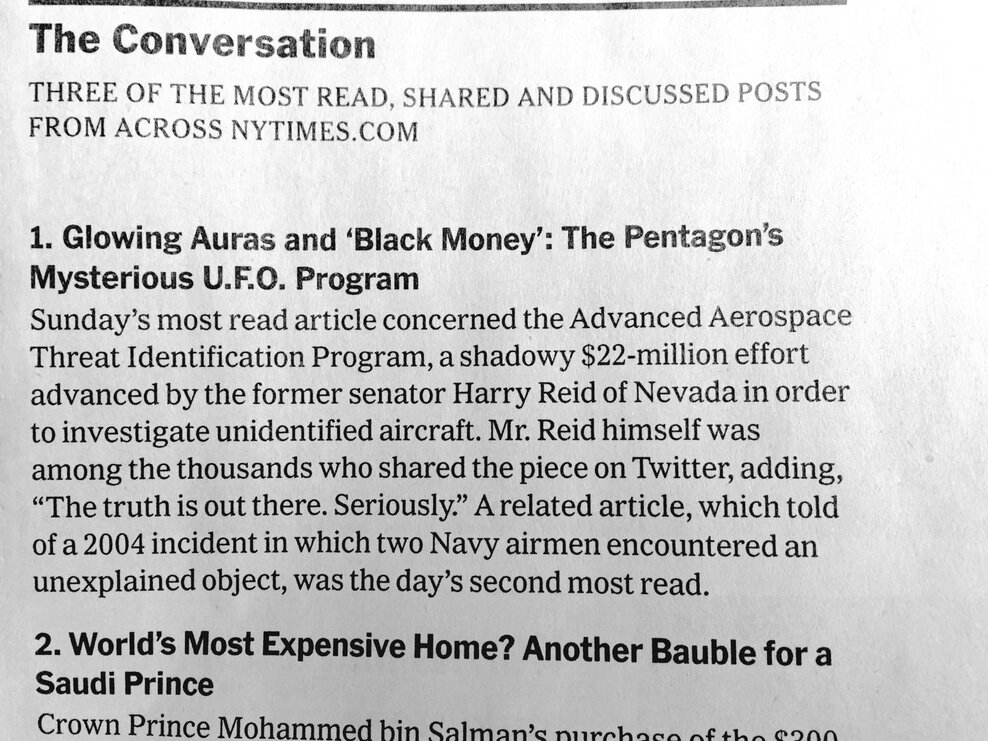 It may have had an unusual title: “Glowing Auras and ‘Black Money’: The Pentagon’s Mysterious U.F.O. Program” but it certainly changed everything in the world of UFOs. There have been other great informative articles since in the New York Times, but this one was on the front page and it started the UFO ball rolling.
Those of us really fascinated with the UFO topic were really paying attention when To The Stars Academy Of Arts & Science launched in October of the same year and ran a livestream featuring their prestigious team consisting of: Luis Elizondo, James Semivan, Harold (Hal) Puthoff, Steve Justice, Chris Mellon, and president, Tom Delonge. We heard some amazing things that day, and there was a real bustle among the UFO community, social media was ablaze for several days, and then things seem to settle down. There was some talk here and there, but the needle wasn’t really moved too far from what I could tell.