By Charles Lear
For most of the modern UFO era, those interested in the subject have depended on private groups for information. The most prominent and enduring of these is the Mutual UFO Network. What many may not know is that MUFON came about as an offshoot of an extraordinary group called the Aerial Phenomena Research Organization that was a mom and pop operation for much of its existence.
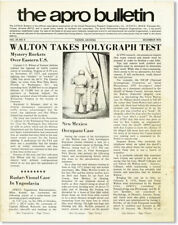 APRO was formed in the fall of 1951 through the efforts of Coral Lorenzen with the help and encouragement of her husband, Jim. Coral’s interest in UFOs preceded the 1947 Kenneth Arnold sighting by more than a decade following her own sighting of an unexplained object. Coral claimed that in 1934, as a young girl with the maiden name, Lightner, she and her two playmates, Barbara Stringer and Dorothy Wethern, saw what looked like a parachute moving across the sky. Coral noticed that it didn’t have any strings and this caused her to question whether what she was seeing actually was a parachute. She told her father what she had seen and he was impressed enough to make inquiries and found that there were no pilots in the area at that time. Three years later, at the age of 12, Coral was being checked for astigmatism and told her doctor what she had seen. He recommended that she read the books of Charles Fort, a writer who was a pioneer chronicler of the strange and unusual, and Coral developed an interest that would stick with her for the rest of her life.
By 1947, Coral had married Leslie James Lorenzen and had become an amateur astronomer. On June 10th, two weeks before Arnold’s sighting, Coral claimed to have seen a light appear next to a mountain in Mexico while looking for meteors from her back porch in Douglas, Arizona. In her words, “It became a tiny ball of light, then suddenly shot up into the sky, eventually disappearing at nearly zenith. After Arnold’s sighting of nine objects flying in formation over Mount Ranier, “flying saucer” sightings became big news and Coral began clipping and saving articles.
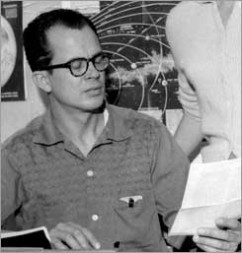 In 1951, Coral and Jim Lorenzen were living in Sturgeon Bay, Wisconsin after a brief stay in Los Angeles. While in Los Angeles, they had met contactee, George Adamski, and Coral reported that she was unimpressed by his claims, in part due to his repeated references to the moon as a planet. In Wisconsin, Coral decided to start a group that would keep track of sightings reports and she wrote to people she knew who might be interested. Around fifty responded positively and the Aerial Phenomena Research Organization came to be. Coral had chosen the name, consciously avoiding the term, “flying saucers” which she found distasteful. The center of operation for APRO was an antique table with clawed feet in the corner of the Lorenzen’s living room and the means of communication among its members was a portable typewriter.
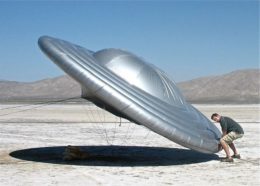 An important factor influencing acceptance is the credibility of the investigator. It should be safe to say at.this point that civilian UFO investigators have more credibility than government employed investigators. This is because, far too often, commonly mistaken objects have been indiscriminately offered as explanations by public officials in order to put a case to rest. This is unfortunate because there are occasions where a good solution to a case that could help clear out some of noise in the signal may be dismissed by many due to what has become a reflexive reaction. From a
  The July, 1947,
  The UFO mystery is not a 20th century phenomenon, but it did in many ways come into prominence in the 20th century. Serious study of UFOs began around World War II and thrived in the following decades. During this golden age of UFO study radio was the dominant form of electronic media. Although film and television existed, radio was a much more important source of timely news and information. Also during this time UFO investigators would find audio recording devices much more portable, reliable and affordable than film equipment. All of this led to an incredible amount of information from the golden age of UFO study being stored in audio formats.
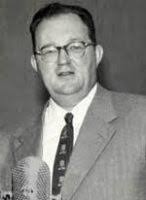 Was the death of Frank Edwards, famous newscaster and UFOlogist, predicted by the space people? This story shows up in a lot of literature from the time and many people took it seriously. An additional oddity offered up in the account is that the time of Edward’s death was a few hours before midnight, June 23rd, 1967. This was almost twenty years to the day after June 24, 1947, which was the date of the sighting by Kenneth Arnold that many consider the beginning of the modern UFO mystery.
 For many people, the late night radio show,
 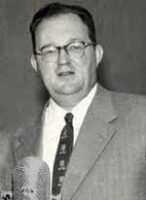 Near the end of the year 1949, Frank Edwards, newscaster for the American Federation of Labor sponsored Mutual Broadcasting System, received an advance copy of the
  The decade of the 1970’s was a strange one in America. The counter-culture of the late 50’s gained momentum through the 60’s and, by the 70’s, it had gone mainstream. Experimentation was everywhere in the arts, culture and politics of the era and the minds of the general population were open to possibilities that were, perhaps, beyond the capabilities of the science of the day to explain. It was a good time for UFOlogy and many documentaries on the subject started to appear in movie theaters that culminated in Steven Spielberg’s 1977 fictional treatment, “Close Encounters of the Third Kind.” The title of the movie comes from
 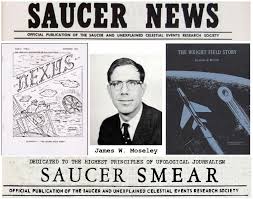 In the early days of the modern UFO era, if you were an American and you saw something strange in the sky and wanted someone to investigate, you reported it to the Air Force. If the Air Force dismissed your case as unworthy of study before 1952, there were no other organizations to turn to. There were a few private individuals who might be willing to look into it, but they were usually under contract with publications such as True Magazine, Look Magazine, and Fate, which meant that there would be some publicity involved. There was a need for a private organization of dedicated researchers and, by the end of 1952, three groups had formed to fill it. The first two were the International Flying Saucer Bureau founded by
  In many ways, the history of UFOs in Canada parallels that of the United States. There are early historical sightings recorded in the 1600’s and 1700’s, mysterious airships in the late 1800’s and a modern era from the 1940’s on. The two countries, concerned about a possible Soviet missile attack, worked closely with each other during the Cold War, monitoring the northern areas, including the Arctic Circle, with extensive radar facilities. Official Canadian UFO policy was then influenced by the U.S. policy, which was to down play reports to the public while quietly investigating them. In later years, the Canadian government became more open about the subject and two of Canada’s most famous cases, Falcon Lake and Shag Harbour, were recently celebrated with the release of commemorative coins from the Canadian Mint. This week’s guest, Chris Rutkowski, is Canada’s foremost UFO researcher and
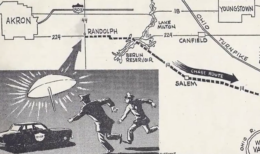
 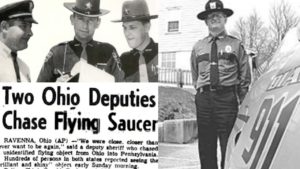 Throughout the history of UFO sightings, police involvement has been fairly common as they are often the first to be called by concerned citizens. Sometimes the officers sent to investigate end up becoming witnesses themselves and there are
 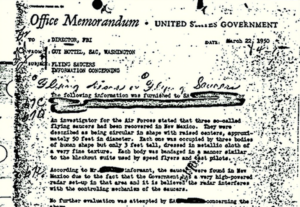 The CIA and FBI were interested in UFOs. It’s on the record and you, the public, can see for yourselves in documents released by both organizations. What’s not entirely evident is the interest those agencies had in civilian research organizations. Did the CIA and FBI plant undercover agents among members of certain groups that had achieved a certain level of popular recognition? Were there operations to discredit prominent researchers and witnesses? Were wiretaps or surveillance devices utilized to monitor researchers and those who provided them with sensitive information? If it can be determined that individuals or groups looking into the subject of UFOs were considered a threat to national security then the answer is, “most likely.”
 Throughout the 20th century it was believed by most researchers that UFOs were physical craft driven by extraterrestrials, ghosts were the spirits of dead people and Bigfoot was a large hominid as yet unclassified by primatologists. In the later part of that era, John Keel, author of “The Mothman Prophecies”, began to consider that all of these might come from a single cause and he began looking for a unifying theory. Now, in the 21st century, more and more researchers are beginning to think this way and some have focused on what have been called “paranormal hotspots” where there is a concentration of reports with many different varieties of strange activity. Investigators have included the father and son team of Paul and Ben Eno looking at areas of New England and Pennsylvania, a team from Robert Bigelow’s organization, the National Institute for Discovery Science (using our tax dollars under a