by UFO History Buff & Author, Charles Lear
Ray Stanford, longtime friend of the show and longtime fixture in the UFO/flying saucer scene, passed away on June 14. In the early days of Podcast UFO, he was a regular guest and caller, and was always enthusiastic and passionate in any discussion he was engaged in. He reached out to me when I was just starting out as a blogger with both praise and caution, and in one instance, chastised me for using a picture of a saucer nest as an illustration for one reported in Westall, Australia, for which there was no picture.
Ray was born on June 21, 1938, and was a colorful and controversial figure on the scene, having started out as a contactee, along with his brother Rex. They cowrote a book together titled Look Up, which was published in 1958 when Ray was just 19. He claimed up until 1980 to be in communication with various entities via trance channeling. Books he’s written on his own have subjects ranging from aura reading (What Your Aura Tells Me, 1978) to the Socorro Incident (A Socorro “Saucer” in a Pentagon Pantry, 1976) involving the report of a landed craft and two humanoids by Socorro Police Sgt. Lonnie Zamora. This is what I wrote in a blog way back when about Ray’s involvement in that case:
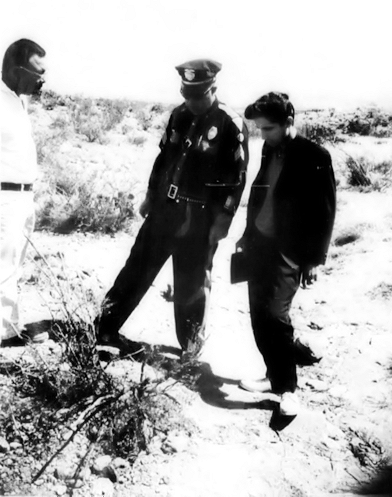
A researcher and NICAP member, Ray Stanford, had arrived in Socorro after Hynek and had tried in vain to make contact with Zamora. He went to the police station on Wednesday morning and was told by the dispatcher, Mike Martinez, that Zamora was in the southern section of town. Stanford, convinced Zamora was at the landing site, asked Martinez to make a call on the radio. Chavez answered and said they wanted privacy while Hynek was investigating, but Hynek interrupted and invited Stanford to come out as long as he came alone.
 When Stanford arrived, he and Hynek discussed another case, and then Hynek took pictures, as Zamora described the object’s entry and exit. Hynek then wanted to take some soil samples but had nothing to contain them. Stanford offered him the use of some vials he had brought along.
Curiosity seekers and souvenir hunters had already taken a lot from the site, but a piece of remaining evidence particularly interested Stanford. Zamora had pointed out a rock in one of the indentations. The rock had scrapes on it, and Zamora reasoned that, if they were caused by landing gear, there might be metal fragments left on the rock that could be tested. Hynek wasn’t interested in the rock, so Stanford returned later, took the rock for his own investigation, and had it tested that year at NASA’s Goddard Space Flight Center. Stanford published a book in 1976, A Socorro “Saucer” in a Pentagon Pantry. In it, he details the initial results of the tests and alleges there had been intervention by the intelligence community in order to suppress them.
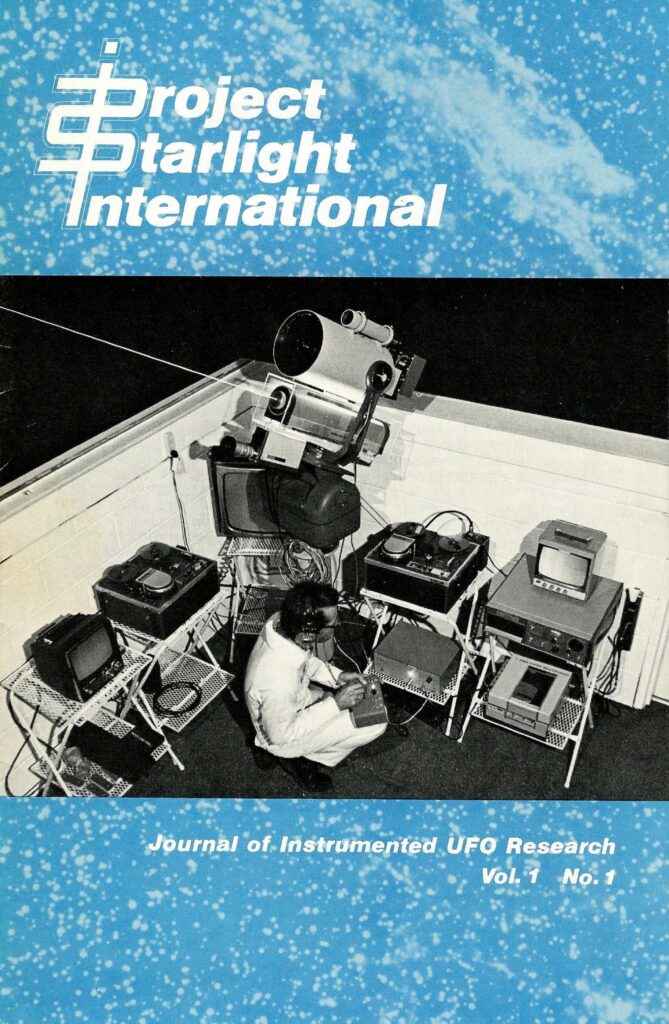
The same year as the Socorro incident, 1964, Ray got backing from some wealthy patrons and set up Project Starlight International in an effort to gather UFO data using lasers, magnetometers, and high-end optical equipment in order to subject it to in-depth analysis. The group put out the Journal of Instrumented UFO Research and was active until the 1980s, although Ray reportedly still attached the name and logo to some of his UFO-related material as late as 2021.
 What Ray became best known for in his later years was footage he shot of UFOs in 1986. Christian Lambright is one of the few people privileged to have seen it and he wrote about it in his 2012 book, X Descending, which I covered in another blog. The following is from that.
According to Lambright, he ended up meeting Stanford at a UFO convention in 1984, and this led to Lambright finding himself in Stanford’s living room in Austin, Texas, in 1986 after accepting Stanford’s invitation to visit him there. Lambright tells the reader he was shown a film by Stanford, taken months before. That film has since become legendary, primarily due to the fact that Stanford has shown it only to a select few and has yet to release it to the public.
Lambright describes seeing a disk that was captured on the film that was oriented vertically and travelled horizontally, the opposite of how a disk is usually described travelling in a Frisbee-like fashion. He says he saw a pulsing beam projecting in front of it with a “subtle pattern” that fanned out ahead of the disk. Lambright says his thought was that the beam was creating a “vacuum corridor.” He says the disk was one of four on film out of the eight Stanford reportedly saw.
After this, Lambright describes his quest to determine whether the technology seemingly demonstrated in the film could have existed on Earth. It wasn’t until 1995 that he came across a paper by a professor and two graduate students from the Rensselar Polytechnic Institute, that he saw a technology breakthrough that resembled what was on Stanford’s film. He says he called Stanford to describe it and as he paused in an effort to properly pronounce the professor’s name, Stanford said, “Oh, that must be Leik Myrabo from RPI. He was at my house a few years ago and spent three days looking at my films!”
 Lambright includes an image he created based on Stanford’s film along with an image he created of Myrabo’s concept, and they are quite similar. Lambright conjectures from this that the technology seen in Stanford’s film wasn’t developed on Earth, and he includes a letter to Myrabo addressing this. He says Myrabo expressed an interest in discussing the matter and that arrangements were made for Stanford to present his film before the International Society for Beamed Energy Propulsion, but “the possibility quickly evaporated” due to the plan to have Stanford’s film run automatically “during breaks and with no commentary at all!” which caused Stanford to refuse to participate.
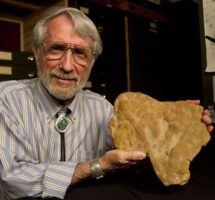
No matter what one may think about Ray’s contributions to UFOlogy/saucerology he did make a contribution to paleontology that can’t be denied. From the article by Riley Black headlined, “Tracking Dinosaurs With Ray Stanford,” posted November 13, 2012, on the Smithsonian magazine website:
Amateur ichnologist Ray Stanford has a knack for finding dinosaur tracks and traces in the Baltimore, Maryland and Washington, D.C. area. Among his recent finds are an impression of a baby ankylosaur–on display at the Smithsonian National Museum of Natural History–and a track made by an adult of a similar dinosaur on the grounds of NASA’s Goddard Space Flight Center.
Ray kept his collection of lower Cretaceous fossil tracks, reportedly the largest and most diverse in existence, in his house in Maryland and had to reinforce the floors to support it.
R.I.P. Mr. Stanford. The UFO world just got a little less interesting.
Bought a copy of Pentagon Pantry from Ray a few years ago- he was quite kind and sent it personally along with a personalised inscription and an invitation to visit him if I was ever in the area. Great book, great fellow who will be missed.