by UFO History Buff & Author, Charles Lear
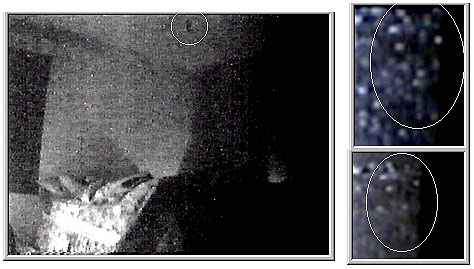 In 2000, Gary Lowrey, a Bakersfield, California, fire safety officer, came forward with the claim that he and his family were being harassed by strange creatures that came through his bedroom closet and left them with pinprick marks on their bodies. He produced physical evidence and video to back up his claim and got the attention of key figures in the UFO community at the time. While one piece of his physical evidence wound up in labs for extensive testing, his video evidence wound up being defended in a court of law.
Lowrey’s story came to the attention of Ventura, California, podiatrist Dr. Roger Leir, who gained notoriety for his claims that he had repeatedly removed anomalous objects from people who believed they had been abducted and implanted with devices by aliens. Leir wrote about the case in the article (page 3 of the pdf) headlined “The ‘Claw’ Scientifically Analyzed” published in the December 2003 MUFON Journal.
According to Leir, “Gary and his family have been involved for many years with numerous conscious memories of actual experiences.” He says that Lowrey had passed lie detector tests and undergone two regressions, one of which was performed by abduction researcher Budd Hopkins. Lowrey told Leir that he was going to try to capture video evidence and did so using a video camera hidden in a clock radio in his bedroom. He gave Leir what he believed was footage of a creature, and Leir gave it to “several video analysts” who saw “evidence of some kind of an image showing a creature in the film.” Other footage showed “balls of light floating through the air.”
The next thing Lowrey did was attempt to get footprints using a piece of “thick tin foil” hidden beneath a towel placed in front of the closet. The next morning, he found two impressions in the foil, made plaster casts of them, and they are described as being small and narrow with three wide toes.
Other evidence Leir says he himself collected and observed included soil samples from a circular area in Lowrey’s yard where nothing would grow that “was consistent with a circular craft landing area,” and “magnetic anomalies” on the exterior walls of Lowrey’s house and two metal hangers in his closet.
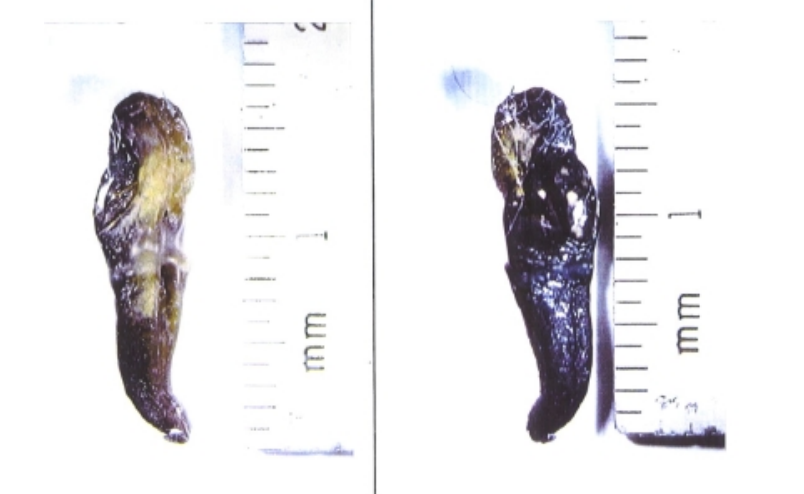 One morning, Lowrey discovered what looked like a claw stuck in the towel and he brought it to Leir. Leir says, “Thus began one of the most vigorous scientific pursuits involving physical evidence in the field of ufology.”
Leir had the “claw” looked at by someone at the Department of Zoology at the University of California at Berkeley, a primate specialist at the San Diego Zoo, and Bill Marlowe, a friend of his who worked at Southwest Laboratories in San Antonio, Texas. The first two specialists couldn’t say what species of animal the claw came from, but Marlowe determined it was made of keratin. Leir decided that the next step was DNA analysis, and he got funding from “several sources” including “contributions from the entertainment industry.”
Bill Chalker wrote about the case (page 201) in his 2005 book, Hair of the Alien. According to him, the three main organizations supporting the testing were his group, the Anomaly Physical Evidence Group, Leir’s A&S Research, and Robert Bigelow’s National Institute for Discovery Science. Colm Kelleher wrote a report summarizing the process titled A Cautionary Tale. Analysis of Alleged Extraterrestrial Biological Material: Anatomy of a Molecular Forensic Investigation.
According to Kelleher, the data that initially emerged was “bizarre and sometimes confusing.” This supported the idea that the object was possibly from an alien creature, but more testing needed to be done, which consisted of “six separate rounds of subsequent DNA analysis,” to reach a firm conclusion. This took 12 months and involved “highly qualified teams of experts in three countries.”
It was finally concluded that the specimen was a “mundane terrestrial mollusk.” The difficulty came about because such mollusks (a snail in this case) create a mucous that inhibits enzymes used in DNA testing. In addition to that, there was a lack of mollusk DNA sequences in global DNA databanks. On the upside, the study resulted in one being added.
In the October 16, 2006, Los Angeles Daily Journal, there is the article by Ryan Oliver headlined “Key Witness in Oil Case Says He’s Regularly Visited by Aliens.” According to Oliver, Lowrey was a key witness for the Santa Barbara district attorney’s office that was suing Greka Energy Corp. for code violations. Lowrey had worked for the company as a safety officer and said he had been ignored when he warned the company about safety issues at their refinery.
The lawyer representing Greka was none other than Bela Lugosi Jr., son of the actor most famous for playing Dracula. In June, he deposed Lowrey and asked during questioning, “Are you still being visited by aliens?” Lowrey said, “On occasions I am, yeah.” Lowrey explained that he wasn’t sure that they were aliens but that he was sure “they’re not human-looking.” He said they left him and his family with pin-prick-sized holes on their bodies, often in diamond-shaped patterns, but added, “I don’t remember a lot of it because, you know, you’re asleep when it’s happening to you.”
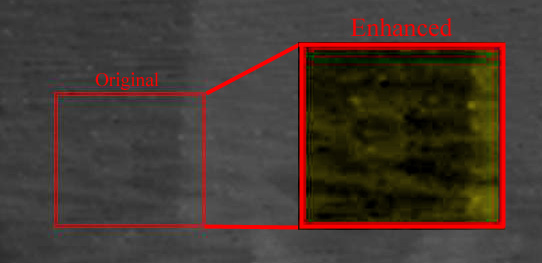 Deputy District Attorney Jerry Lulejian supported Lowrey and said he had watched one of Lowrey’s videotapes. He told the Journal, “I’m going to argue in court that there is something going on in these videos that substantiates what Gary Lowrey is talking about.”
Part of Lowrey’s testimony included his finding the “claw,” enlisting the help of Leir, and the discovery that it was most likely, according to Oliver, a “snail shell.” Lulejian told the Journal that he was considering having Leir testify.
Lulejian was deposed in August, and he continued to defend Lowrey’s claims in court: “He’s showed me he’s rational, he’s showed me that there are things going on outside of him, and he’s showed me proof that they’re there. Everything he’s said in his deposition so far checked to be true based on what he’s said in his – or what I’ve seen on videos and what’s in the reports.”
Lugosi told the Journal he was surprised that the county was going to try to bring Lowrey in as a witness against Greka: “Obviously, credibility is important. It’s not every day you have a code enforcement matter which involves aliens in the closet, mysterious claws, and a podiatrist who removes alien implants.”
The case was settled later that year without having to go to trial.