by Charles Lear
 These days, more and more researchers are considering the idea that there is a unified theory for all things paranormal from Bigfoot to ghosts to UFOs. The idea that all, or at least many, things paranormal derive from a common source was considered as early as the 1940s by Meade Layne and other members of the Borderland Sciences Research Association. This has been popularized in more recent times by John Keel and Jaques Vallée. There was a great deal of resistance to this way of thinking among paranormal enthusiasts, but a case in Pennsylvania from 1973 has elements to it that that likely caused many to reconsider their positions.
The case is described by Berthold Eric Schwartz, M.D. in the July 1974 issue of Flying Saucer Review in his article, “Berserk: A UFO Creature Encounter.” According to Schwartz, he got a call on a Sunday in September from Allan Noe of the Society for the Investigation of the Unexplained (a New Jersey based organization founded by Ivan T. Sanderson) and Stan Gordon, director of the Pennsylvania based Westmoreland County UFO Study Group. They told him they were in the midst of a great deal of activity involving UFOs and creatures. Gordon, in the documentary, Invasion on Chestnut Ridge, describes the activity as “a major UFO-Bigfoot wave.” Read more
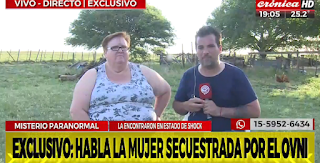 In last week’s blog, we looked at a recent report from the Pampas region of Argentina that involved a missing woman who was found the next day in a town around 65 km from where she was last seen. She reported being in her yard in Jacinto Aráuz, seeing a light, and then suddenly finding herself sitting on a road in the town of Guatraché with no memory of how she got there. The case caught the interest of a local UFO researcher, as it bore a resemblance to an alien abduction case reported in the area in 1983. The researcher was interviewed in connection with the story in the local paper La Arena and the woman’s disappearance was presented in the paper with the alien angle in mind. Since the last blog was posted, the woman has come forward and was i
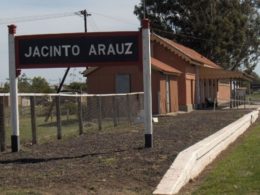 Just weeks ago, there was an intriguing incident reported in Argentina involving a woman who went missing and was then found a day later, 65 km from where she was seen last. She had no memory of how she got there, and local residents and Argentinian officials were mystified. The case aroused the interest of a local UFO researcher who noted a similarity to an earlier alien abduction case in the area.
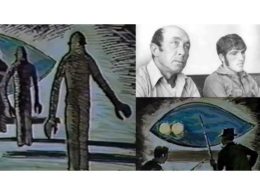 In 1973, there was a worldwide wave of UFO associated humanoid encounters. Arguably, the most famous of these was the alleged abduction in Pascagoula, Mississippi, of Charles Hickson and Calvin Parker. They reported being forcibly taken aboard a craft by three, approximately five-foot-tall, robot-like, elephant-skinned creatures with crab claw-like hands, no eyes, a slit for a mouth and cone-shaped protrusions where the nose and ears would be on an earthly creature. While the creatures described by Hickson and Parker are unique in UFO literature, what is common to the 1973 humanoid wave is that most of the creatures described were unique. One report that stands out came from the city of Vilvoorde in Belgium. It was investigated by the Societé Belge d’Etude des Phénomènes Spatiaux, and an article describing the reported encounter written by Jean-Luc Vertongen appears in the SOBEPS journal,
 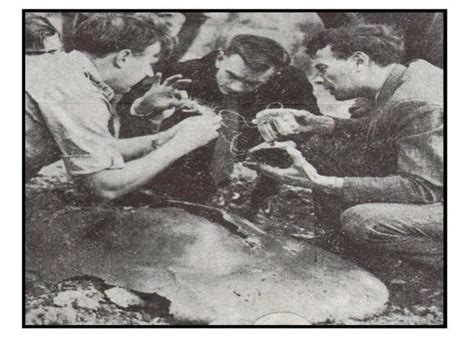 In 1957, the same year the Soviets launched Sputnik, British authorities, media, and citizenry had their attention drawn back down to Earth as they attempted to unravel the mystery of a flying saucer said to have been found laying in a moor. It was dismantled, studied, and opinions were divided between its having come from space and its having been manufactured right here on Earth. Over time, the saucer went missing, but the mystery as to its origin remained. Then, in 2018, pieces of the saucer and its mysterious contents were found in the archives of the Science Museum in London.
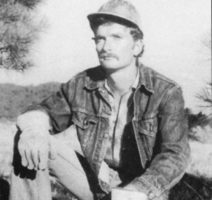 One of the most famous early abduction cases is that of Travis Walton in late 1975, which received a lot of attention and still fascinates many people to this day. Walton’s case was investigated primarily by the Aerial Phenomena Research Organization. In the midst of that investigation, APRO was contacted by Johnny Sands, a country western singer who claimed he had encountered two humanoids in the desert outside of Las Vegas, Nevada. It is perhaps because of the attention given to the Walton case, that Sand’s case has all but been forgotten. I might also be because it’s seriously weird.
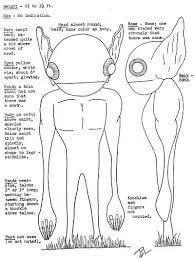 On August 21, 1955, there was an incident that took place on a farm located in the town of Kelly, 7 miles north of Hopkinsville, Kentucky that reads like it was straight out of a ‘50s sci-fi comic book. The story has been recounted in many books and all over the internet but, because of its comic book nature, that it involved real people who were deeply affected and real people who did earnest and laudable investigations tends to be overlooked.
 Of all the private organizations devoted to UFO investigation, the National Investigations Committee on Aerial Phenomena was arguably the most ambitious and tenacious. This was driven in large part by its director, Donald Keyhoe. Keyhoe held the beliefs that UFOs are extraterrestrial and that the U.S. Government, particularly the Air Force, was keeping information from the public that could possibly prove the ET hypothesis. As effective as NICAP was at hounding the Air Force and convincing many in the U.S. Congress that UFOs were deserving of scientific study, there are indications that the CIA was involved in both the beginning and the end of the organization.
 Todd Zechel wrote about the CIA – NICAP connection in the January 1979 issue of
 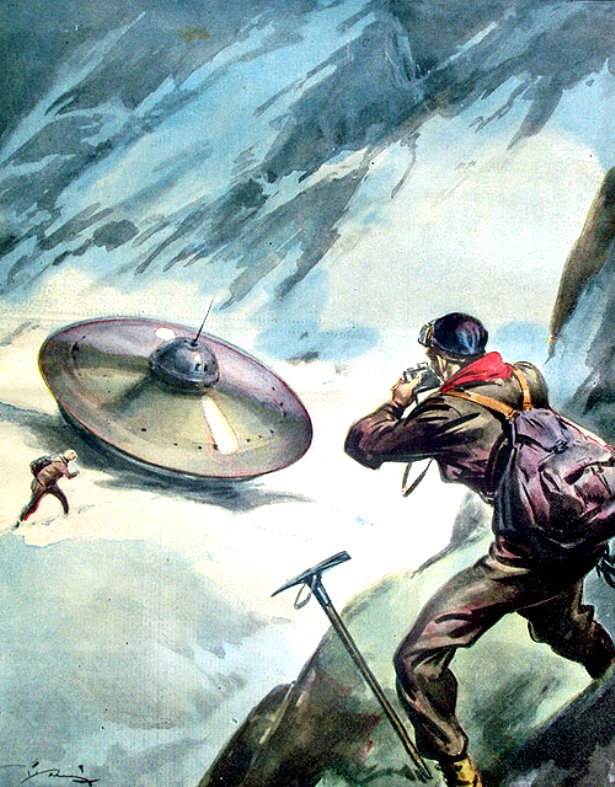 In the hunt for proof that strange vehicles are flying through our atmosphere, possibly under the guidance of alien pilots, researchers have long looked to photographs. There are some, such as the
 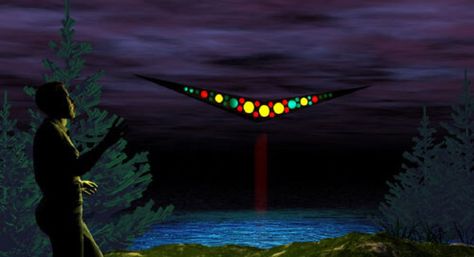 by Charles Lear
 From February 17 to February 24, 1954, President Dwight D. Eisenhower was in Palm Springs, California, on what was described to the public as a “vacation.” On February 20, he disappeared from public view and rumors spread to the point that the headline, “Pres. Eisenhower died tonight of a heart attack in Palm Springs.,” appeared on the Associated Press newswire. The story was removed two minutes later and the AP reported that he was still alive. UFOlogists have speculated on where he was that day, and some have come to the conclusion that Eisenhower went to Muroc Air Force Base for a secret meeting with alien visitors.
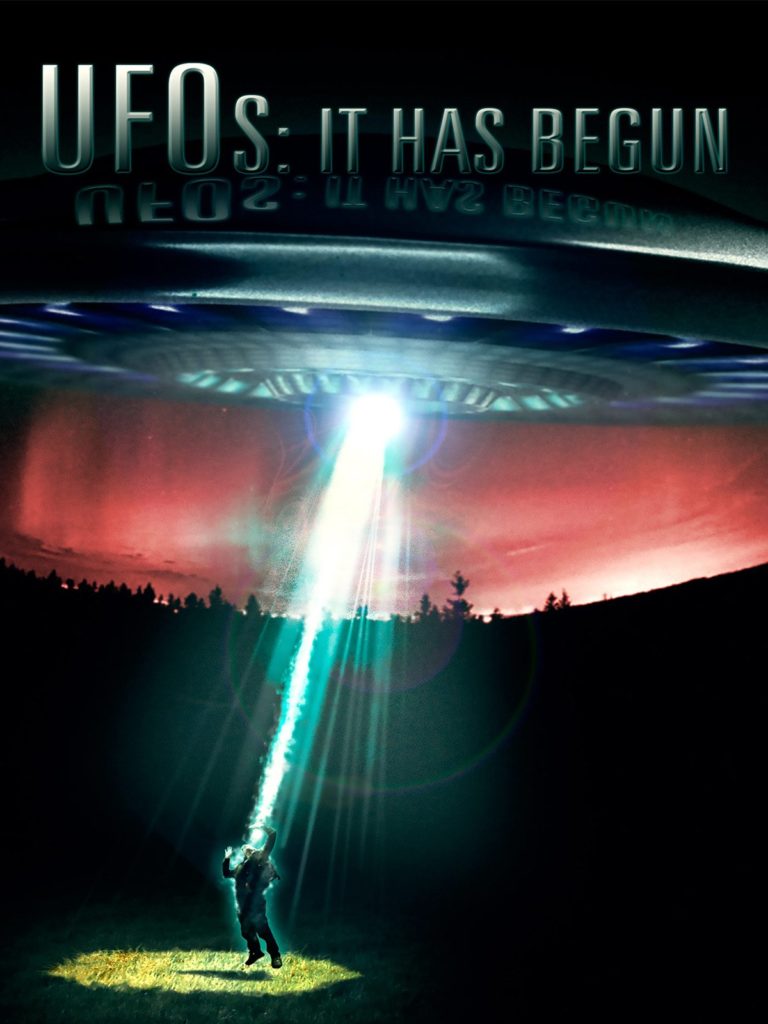 UFO documentaries, besides being informative and entertaining, also serve to preserve UFO history for future researchers. However, one documentary, “UFOs: It Has Begun.” has itself become a part of UFO history. One of its producers has claimed that the U.S. Department of Defense offered him and his partner the use of some film footage taken by the Air Force at Holloman Air Force Base. According to him, it showed a UFO landing and a meeting between its occupants and Air Force officials, and it was going to be the finale of the documentary until the DoD withdrew the offer at the last minute.
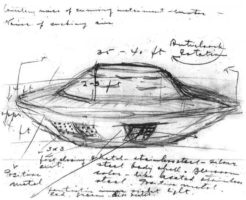 1967 was quite a year in UFO history. In Canada there was the