by UFO History Buff & Author, Charles Lear
 Brazil has a history of official UFO investigation almost as long as that of the United States. However, it has an official policy on disclosure that predates the U.S.’s by more than a decade. In 1954, the Brazilian Air Force started The First Confidential Inquiry into Unidentified Aerial Objects in response to the first major flap in that country. In 1969, the Sistema de Investigação de Objetos Aéreos Não Identificados (SIOANI) was established, and nearly 100 detailed case files were accumulated up until its termination in 1972. After this, in 1977, in response to reports of injuries and deaths as a result of UFO encounters in the area of Pará (mainly in Colores) Operação Prato was authorized by Colonel Protásio Lopes de Oliveira. This resulted in more than 2000 photos, 16 hours of film, and a 179-page report. The First Confidential Inquiry, SIOANI and Operação Prato files were classified for decades, but thanks to a freedom of information campaign begun in April of 2004 by the Brazilian UFOlogist and publisher of UFO Revista, Ademar José Gavaerd, many of the files were shown to him and other UFOlogists in 2005 as a prelude to releasing them to the general public. Then, in 2010, Brazil issued Ordinance 551/GC3, requiring every branch of the military and aviation sectors to collect and transfer all UFO reports to the Aerospace Defence Command in Brasilia along with any material proof by way of photos or video on a yearly basis. There, it is to be catalogued and made available to the public. Along with this, since 2012, the Air Force has periodically released declassified files through the Brazilian National Archives, and recently released 893 reports in May of this year. In this blog, we’ll look at the history of the Air Force investigation, the efforts of Gevaerd and other UFOlogists to gain access to the case files, and some of the most interesting (at least to us) cases (translated files can be found here) found within them. Read more
Podcast: Play in new window | Download
 In the course of researching UFO cases in Spanish speaking countries, one is bound to run into Scott Corrales and Inexplicata: The Journal of Hispanic UFOlogy. It exists today as a
  In the August 1975, APRO Bulletin, the front-page
 In the January 12, 1982, New South Wales, Australia Pix-People, there is an
  Near the end of the 20th century, human abducting, cattle mutilating, Grey aliens flying sport-model saucers dominated the popular UFO narrative. However, there are reports that differ greatly from such accounts that offer insight into what might be an even stranger phenomenon. In the September 12, 1999, edition of the Trenque Lauquen paper, La Opinión, there is an
  In last week’s
  Men in Black stories are almost as old as the modern UFO mystery, starting with the 1947 Maury Island Incident. This aspect of the phenomenon became firmly cemented with Gray Barker’s 1956 book, They Knew Too Much About Flying Saucers, and it plays a big part in John Keel’s 1975 book, The Mothman Prophecies. Keel was of the mind that MiBs were not human beings from secret government organizations out to silence witnesses, but creatures of a much stranger origin. Supporting this is a 1981
  Brazilian UFO cases have aspects to them that, while not unheard of in other countries, come up over and over again giving them a commonality that is unique to Brazil. Lost time, traveling long distances in trucks and cars in far less time and using far less fuel than it should take, humanoid encounters, and injuries are a few of these. A case from 1980 has all of these aspects except injury, and it is described in the cover story of the March 1982 APRO Bulletin.
 Coming across contemporary UFO cases of interest these days when government-related UFO stories dominate the news is difficult. Fortunately, there are still some active civilian investigators out there who share their information (without a subscription) on their websites. Stan Gordon is one of those, and he helped bring attention to a case investigated by fellow researcher Jim Brown.
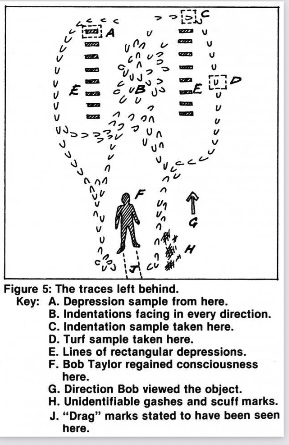 In last week’s blog, we looked at a case involving a 1979 report by a forestry worker in Scotland who said he not only saw a mysterious domed object sitting on the ground, but that he was assaulted by two spherical objects with spike-like protrusions that rolled towards him rapidly, rolled over onto his sides, and seemed to be pulling on his pants. At this point he went unconscious. According to him, when he came to, he heard a “whooshing” noise and then saw that the object was gone. He was extremely thirsty, had a headache, pain in his chin and legs, and couldn’t walk or speak. He crawled back to his pickup truck, which was 300 meters away, found himself incapable of driving it, but was then able to make his way home on foot. Upon returning “with others” the next day, there were physical traces seen that gave support to his claims. This week, we’ll look at the aftermath and the physical evidence.
 When a single witness reports an episode of high strangeness involving a UFO encounter, having physical evidence in the form of traces left on the ground, or on the witness, really helps when arguing for the witness’s credibility. This was the case in the 1979 report by a forestry worker in Scotland who said he not only saw a mysterious domed object sitting on the ground, but that he was assaulted by two spherical objects with spike-like protrusions that rolled towards him. The case got the attention Flying Saucer Review Editor Charles Bowen, who made arrangements to have it investigated by members of the UFO Investigators Network, an organization funded by FSR and formed in 1977 with the help of Jenny Randles who had proposed the idea. The resulting three-part report by UFOIN investigators Martin Keatman and Andrew Collins appears in the