by Charles Lear
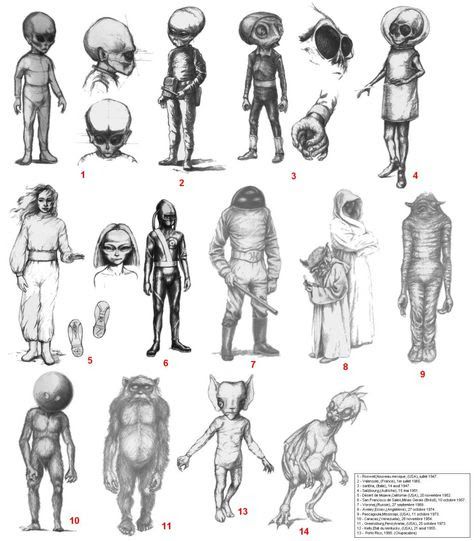 In last week’s blog, we looked at a case that involved an encounter with a UFO occupant that didn’t fit the profile of the iconic Grey-type alien. There were many such cases reported in the press up until the 1980s. Then, the Greys, the Reptilians, and the occasional Insectoids seem to have pushed the others aside, but even these don’t show up too often in the papers. UFO occupants, especially those that don’t fit what has become the standard model, have become personae non gratae for most newspaper editors, and this seems to have created the impression that they haven’t been reported by witnesses.
From the 1950s into the 1970s, there are UFO occupant cases with extensive documentation including: newspaper articles containing first-hand witness accounts, affidavits, witness reports submitted to government and private investigators, police records, and sometimes medical reports when the encounters weren’t entirely friendly. The documents can be found in the files of the Aerial Phenomena Research Organization, the Center for UFO Studies, and other organizations that were open to such reports. The National Investigations Committee on Aerial Phenomena, headed by Donald Keyhoe, was noted for rejecting most occupant reports.
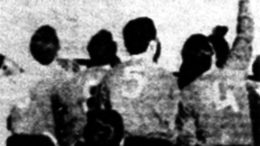 Back in the days before aliens took on the form of the standardized “Grey” model, they came in all shapes and sizes. UFOlogists called them “humanoids,” and there was a wave of them in France in 1954. In 1955 they started popping up in the United States and worldwide. Many UFOlogists, who were trying to convince the scientific community that the mystery was worth studying, tended to reject humanoid reports. Some, such as Coral and Jim Lorenzen of the Aerial Phenomena Research Organization, kept an open mind as long as the humanoids didn’t talk. If a witness reported they had had a conversation and were taken to another planet, that case was tossed into the
 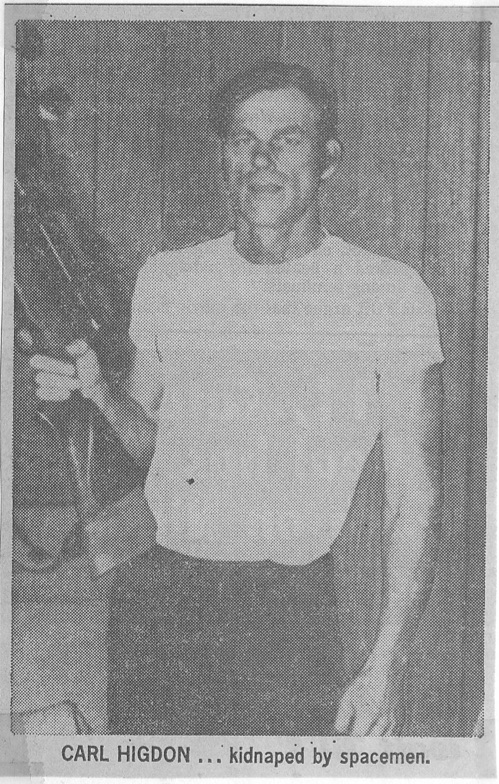 On Oct. 25, 1974, Rawlins, Wyoming resident Carl Higdon decided to take the day off from his job as foreman for an oil drilling crew. One of his “key men” was sick with the flu and he didn’t think anything would be accomplished that day. It was the peak of elk hunting season, and he had just bought a 7mm Remington Magnum rifle, so he probably didn’t have to think for too long about how he would be spending the day. He loaded up his company’s two-wheel drive pickup truck and headed for McCarty Canyon in Carbon County.
 In 1966, there was a UFO case that involved a chase and sightings by multiple police witnesses. In addition to their testimonies, there was a reported radar confirmation and a possible pilot witness. Faced with all this evidence, the initial Air Force investigation consisted of two phone calls to a single witness. Based on interviews lasting a total of around four minutes, the conclusion was that the officers had seen a satellite and chased the planet Venus. The case was re-evaluated after a more thorough investigation, thanks to the efforts of an outraged congressman, and the conclusion was . . . that the officers had seen a satellite and chased the planet Venus.
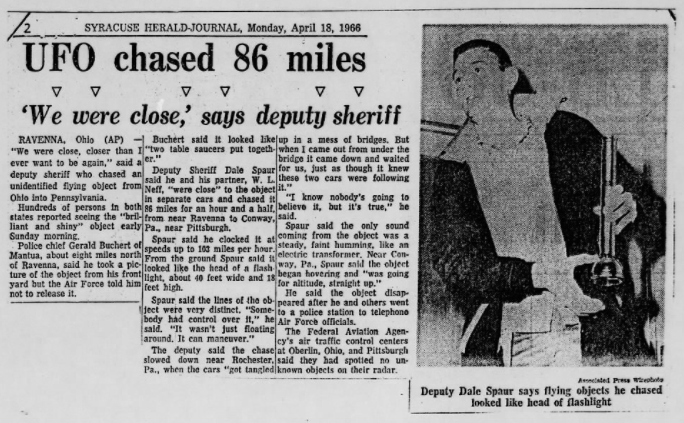 At around 5:00 a.m., they saw an abandoned vehicle on Route 224 near Ravenna, and got out of their car to investigate. According to Spaur, he was in the habit of looking behind him to make sure no one was sneaking up on him. He turned around and saw a light over the trees of a nearby hill. He alerted Neff, and as they watched, it moved over the police car and hovered. They could now see it was an object 35 to 40 feet wide, with a bright, white glow that lit up the area around the car. It hummed “like a loaded transformer.”
 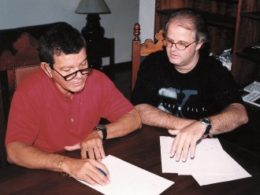 The name was chosen by Captain Uyrangê Hollanda. He explained his choice to researchers Ademar José Gevaerd and Cynthia Luce. Because he was not able to use the expressions, “flying saucer” or “flying disk,” he “chose a cousin of a saucer, a plate.” According to him, the expression in Portugal is “flying plate.” The popular expression in Brazil is “discos voadors.”
 The UFO mystery is not a 20th century phenomenon, but it did in many ways come into prominence in the 20th century. Serious study of UFOs began around World War II and thrived in the following decades. During this golden age of UFO study radio was the dominant form of electronic media. Although film and television existed, radio was a much more important source of timely news and information. Also during this time UFO investigators would find audio recording devices much more portable, reliable and affordable than film equipment. All of this led to an incredible amount of information from the golden age of UFO study being stored in audio formats.
 The first case comes from a report in the