by Charles Lear, author of “The Flying Saucer Investigators.”
By the end of the 1970s, after the 1973 Pascagoula incident and the 1975 Travis Walton case, abduction claims were not only an accepted aspect of the UFO mystery by many investigators, they were considered worthy of attention by the news media, and there are many lengthy newspaper articles detailing reports throughout that decade. The narrative hadn’t yet been taken over by the now-common reports of being taken aboard a craft by creatures 3 to 4 feet tall with big, slanted, black eyes and being subjected to invasive medical procedures that seemed to have something to do with reproduction. The creatures and the natures of the encounters reported throughout the 70s were varied, but by the decade’s end, elements had emerged that would become common in the decades to come. What would also become common in such cases would be the use of regressive hypnosis, which was thought to be an effective means to recover lost memories. However, this technique has since came under criticism, particularly in its use to provide evidence in legal cases, as can be seen in the article titled “Hypnosis, Memory and Amnesia” which was published in the November 29, 1997 (pp. 1727-1732) Philosophical Transactions of the Royal Society London B: Biological Sciences. Read more
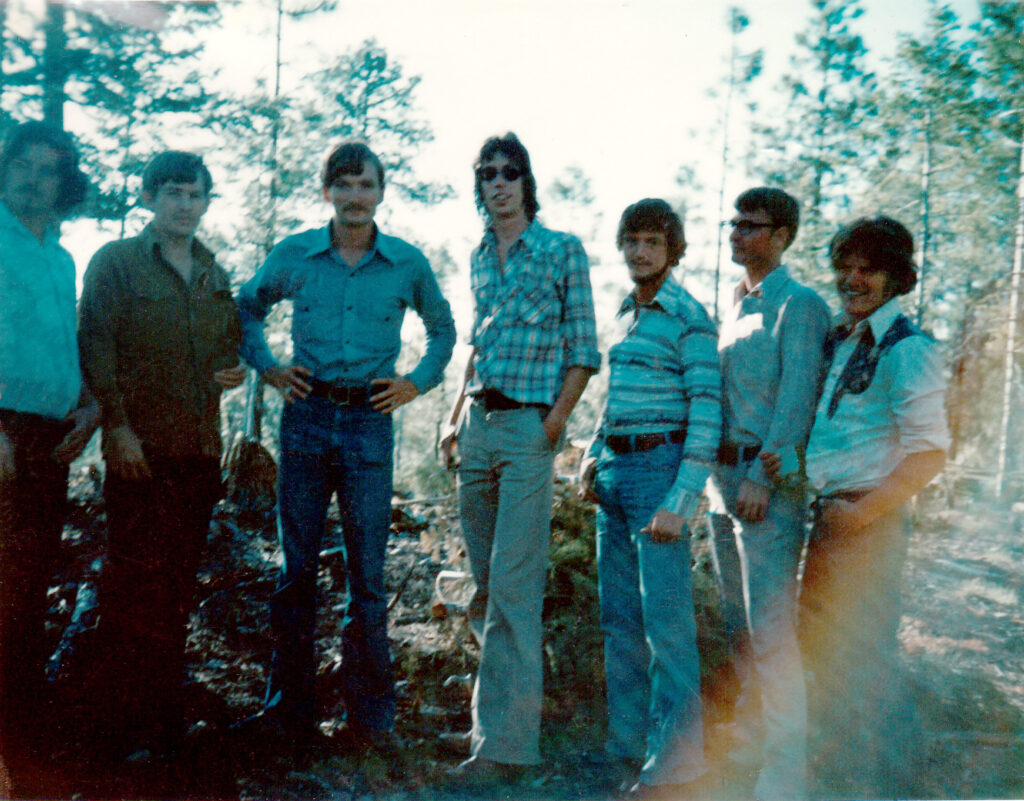
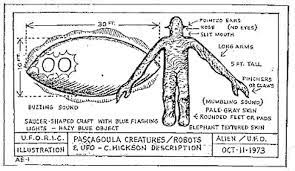
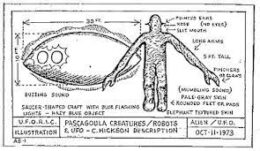 In 1973, the claims of Charles Hickson and Calvin Parker that they’d been abducted by elephant-skinned, robot-like creatures in Pascagoula, Mississippi, opened researchers up to what have become known as “high-strangeness” reports. The term comes from J. Allen Hynek’s efforts at creating a system of strangeness ratings in Chapter Four of his 1975 book, The UFO Experience. Hickson and Parker were taken seriously because they seemed genuinely traumatized by their experience while just the two of them were waiting in a room at the police station where they first reported their encounter. They just been interviewed, and unbeknownst to them, a tape recorder in the room was left running, which captured the bewildered men talking to each other about their experience. Their story was reported in newspapers and UFO publications worldwide. After that, abduction reports began to increasingly appear. In the midst of this new openness to high-strangeness reports, in 1979, there was a story told by a trucker that was highly unique, and highly strange, and yet was still given serious consideration by the local newspapers and investigators who examined it.
  Many readers may not be aware that, at one point in time, the National Enquirer was associated with serious UFO research in spite of its reputation as a sensationalistic supermarket tabloid. In 1972, the Enquirer put together what they called “The National Enquirer Blue Ribbon UFO Panel,” which was made up of five UFO researchers, all of whom held PhDs. The Enquirer was offering a $50,000 reward for proof, by the end of the year, that UFOs came from space and were not a natural phenomenon. The panel was tasked with evaluating UFO cases to determine if any of them provided such proof. The panel members included four consultants for the Aerial Phenomena Research Organization, and Dr. J. Allen Hynek, a scientific consultant for the Air Force’s UFO investigation for most of its existence. All of them had good reputations within the UFO community, and the reader may wonder why they would put those at risk by being associated with the Enquirer in such an endeavor. It’s likely that the prospect of getting some of their research funded by the Enquirer may have helped them to put aside any aversions, and the assignment in 1975 of
  1973 was a special year for UFO enthusiasts. Not only were there a huge number of reports in the
 newspapers as can be seen in the
  In last week’s
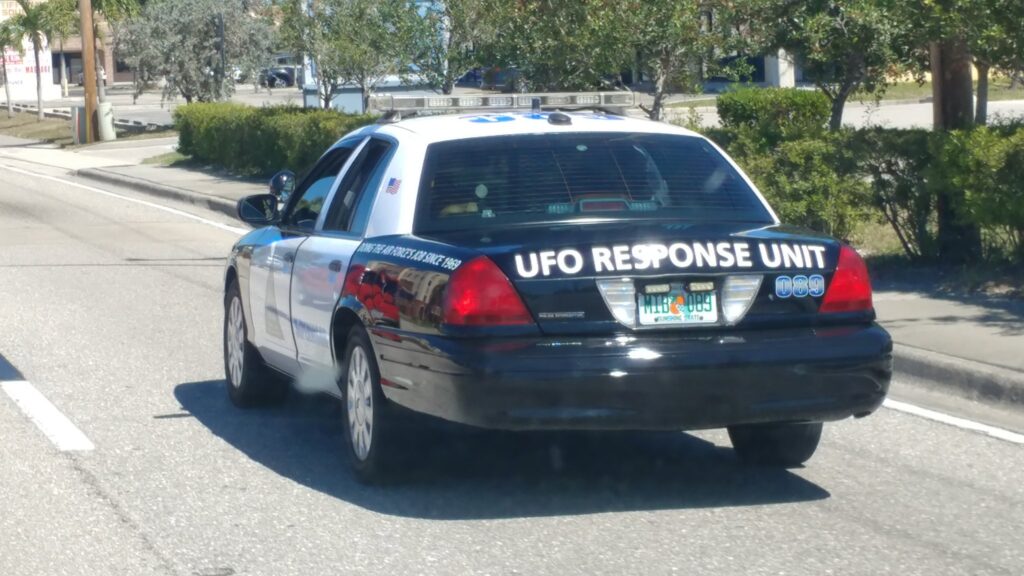 When it comes to reporting UFO sightings, it often happens that local police departments are the first organizations witnesses turn to. Many times, the reports to police take place while the UFO is still active in the area and patrol officers are able to respond and verify witness accounts. Famous examples are the 1966 case involving Dale Spaur and his partner, Wilbur “Barney” Neff, who chased a UFO from Portage County, Ohio, all the way into Pennsylvania, and another Ohio case, this time in Trumbull County in 1994, involving multiple officers chasing and observing UFOs. Their radio interactions have been preserved in the form of a

 In last week’s
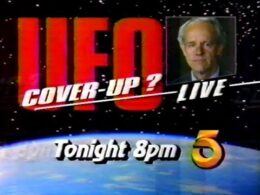 If one was to pick a point when UFOlogy went off the rails, October 14, 1988, is one to consider. That was the date that a television show, UFO Cover-Up? Live!, aired on 130 syndicated channels throughout the United States. It was a flop, but an examination of the people who were involved in the production provides insight into how it came to be that a few dubious individuals left us with what have been convincingly argued are bogus stories and documents that support the idea that the GOVERNMENT has recovered crashed alien spaceships and bodies. A lasting belief is that this came about as the result of an organized GOVERNMENT disinformation program targeting the UFO community. A question this writer is examining is whether or not this too is bogus.
  Throughout the history of UFOs there are stories that become well known throughout the UFO community and beyond, and more often than not, their origins can be found in archives available online. Sometimes a