by Charles Lear
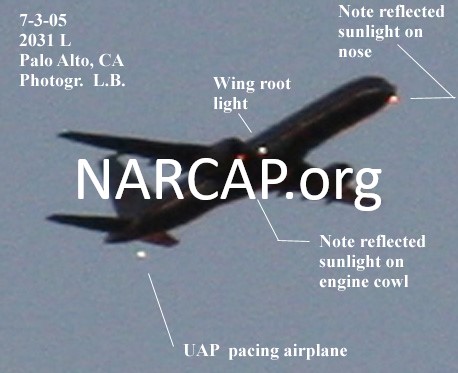 Because the F stands for “flying” in the acronym UFO, it stands to reason that pilots should frequently be UFO witnesses. They certainly are and there is even a specialized reporting center just for them. The National Aviation Reporting Center on Anomalous Phenomena was founded in 1999 by Dr. Richard M. Haines. The organization is dedicated to the study of Unidentified Aerial Phenomena and their effects on aviation safety. By the way, Dr. Haines finds the UFO designation for the phenomena so distasteful, he refuses to appear on Podcast UFO. Most pilots prefer to remain anonymous, as publicly admitting to seeing a flying saucer is not usually an enhancement to their careers.
There are, however, sightings that have made national and international news, with the pilot’s name included. These go as far back as 1947 with the sighting by Kenneth Arnold and another that same year by his soon to be friend, E. J. Smith, along with his crew. But, sometimes, there are encounters where planes disappear from radar and pilot witnesses are not left behind to tell their tales.
When approaching this subject, it’s natural to begin with the Bermuda Triangle and the tragic Dec. 5, 1945 case of Flight 19. This involved five TBM Avenger Torpedo Bombers that took off on a training mission and never returned. Twenty-seven men were lost and never seen again. Though some have speculated that aliens were responsible, there is no record of the pilots reporting any UFOs. A more plausible explanation is that the leader became confused, lost trust in his compass and led his squadron far into the Atlantic where they ran out of fuel.

 The 1975 book by John Keel, “The Mothman Prophecies,” is a complex book. The book’s through line centers on events in Point Pleasant, West Virginia from Nov. 15, 1966 to Dec. 15, 1967. These involved UFOs, sightings of a winged humanoid with glowing red eyes dubbed “The Mothman” and the collapse of the Silver Bridge, which spanned the Ohio River. But, the book is about so much more than that. It can be read several times and, depending on the reader’s perspective, be a completely different experience each time. It contains contactee stories, abductee stories, MiB encounters, Grinning Man encounters, a nighttime bedroom invader in a checkered jacket, strange metallic voices on the telephone, paranoia, poltergeists and prophecies. The reader can dive in repeatedly and come up with a tale that is interesting enough on its own to warrant further research. The tale involving Jaye P. Paro, Apol and Princess Moon Owl is one of those.
 John Keel was a New York City resident and freelance writer who traveled the world looking for stories. During the period covered in “The Mothman Prophecies,” he was dividing his time, investigating strange events in both Point Pleasant and Long Island. The Long Island tale begins in the book with Keel’s investigation of reports of strange visitors by residents living on Mount Misery. Mount Misery is the highest point on Long Island at 400 ft and, put simply, is a big pile of gravel left behind by the last glacier that stopped by around 20,000 years ago. One resident there told of being visited by four men, three of whom looked “like Indians.” They politely told her that her land belonged to their tribe and they meant to reclaim it. She was “frightened” by their feet. They had no car and would have had to walk through mud to get to her house and yet they had none on their shoes. Keel was running into many similar stories of people who didn’t seem to quite fit in. He was becoming convinced that the people being described were extraterrestrials from another planet, or ultraterrestrials from another dimension.
 In the world of UFOlogy, some stories continue on, even after they’ve been convincingly debunked. This is often due to a particular story’s entertainment value and, it should be remembered, many UFO stories exist in an area between fiction and fact. If we were to assign this area a genera name, perhaps “true science fiction” might be appropriate. The idea that a fantastic story could be true, makes the story that much more interesting and suspension of disbelief is something everyone engages in when they want to be entertained. One such story, a biographical tale under the byline, Fred Reagan, appeared in the May 1953 issue of Action magazine. It could be held up as an example of what many paranormal enthusiasts call, “high strangeness.” However, it seems to be what folklorists call, “a tall tale.”
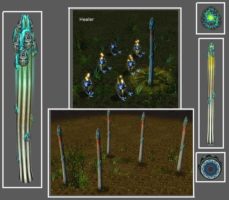 He found himself inside a dimly lit room surrounded by strange beings. They were around three feet tall and resembled “huge stalks of metallic asparagus.” He lost consciousness. When he came to, a metallic voice spoke to him through a speaker. Using broken English, the voice apologized for the collision, saying it had been an accident. It explained they were here to observe our primitive civilization and that their mission was peaceful. The voice further told him that they’d examined him and found a cancerous tumor, which they “adjusted.” He was instructed not to talk about the incident, as no one would believe him.
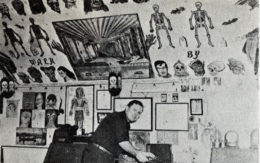 In the early years of the flying saucer mystery, the U.S. Air Force was the only organization doing any sort of significant investigation. Then, in 1952, a number of private groups were organized and the first citizen investigators went into the field and endeavored to solve the mystery for themselves. The first of these to rise to global attention was the International Flying Saucer Bureau, founded by Albert K. Bender. They put out a quarterly publication called Space Review, and were taken seriously by their fellow enthusiasts. They didn’t last long, however, as Bender put an end to his creation in 1953 after telling his followers he had solved the mystery. He later informed them he’d been visited by three men wearing black suits and homburg hats, who’d threatened him into keeping silent about his discovery. The mythos of the Men in Black entered flying saucer lore and the Bender Mystery became a subject that is still being debated today.
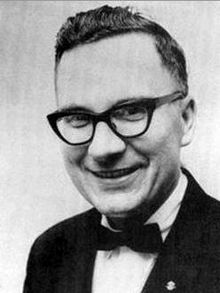 Albert K. Bender was born on July 16, 1921 in Duryea, Pennsylvania. What the “K” stood for seems to be part of the mystery. He served stateside as a dental technician in the U.S. Army Air Forces from June 8, 1942 to Oct. 7, 1943. He was stationed at Langley Field, Virginia. After his service, he moved to Bridgeport, Connecticut with his mother and stepfather. His mother died shortly thereafter.
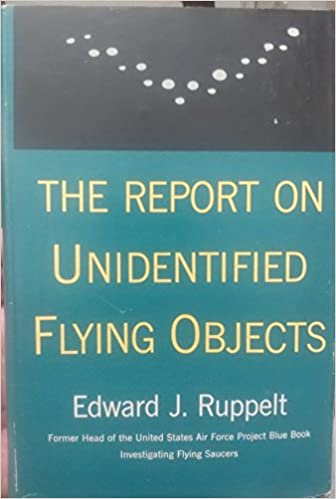 The 1956 book by Edward J. Ruppelt, “The Report on Unidentified Flying Objects” is a must-read for anyone interested in the subject. Capt. Ruppelt was the first director of Project Blue Book after leading a massive re-organization effort to revitalize the investigation while it was still operating as Project Grudge. He was the person who came up with the designation, Unidentified Flying Object, or UFO, which was pronounced “yoofo”, for what were popularly known as flying saucers. His book recounts his time with the project under both names and provides an insider’s view of what were then classified activities. There are two editions of the book with two different endings. The second edition was published in 1960 and Ruppelt included recent cases as a means to update the book. This edition has three more chapters tacked on that have a decidedly more negative tone than the original preceding chapters, where Ruppelt displays an open-minded view. This has led some to wonder if Ruppelt was pressured by the Air Force, which was then following the
 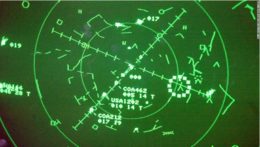 The state of Michigan is best known to UFOlogists as the swamp gas state. This is because of Project Blue Book scientific consultant, J. Allen Hynek. He came up with the explanation that swamp gas was responsible for sightings that were reported there. That was way back in 1966. It caused a furor that led Michigan representative and House Minority Leader, Gerald Ford, to call for a hearing in Congress. The case is based on multiple witness testimonies, which include those of police officers, and is well represented in UFO literature. However, there is a more recent, and less well-known case that not only has multiple witnesses, but radar confirmation and a 911 dispatch tape as well.
 On the night of March 8, 1994, meteorologist Jack Bushong was manning the National Weather Service office in Muskegon. He received a call from an Ottawa County dispatcher who’d been dealing with multiple reports of mysterious lights in the sky. The dispatcher wanted to know if there was anything on radar to confirm the reports.
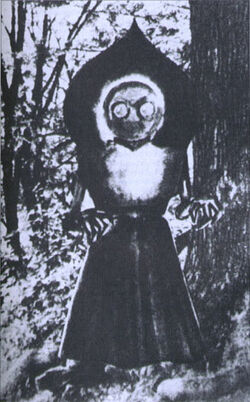 Much has been written about the 1952 Flatwoods Monster encounter in Braxton County, West Virginia. It is a bizarre tale that received national press coverage at the time and it is still celebrated today as part of West Virginia’s weird history. You can have your picture taken in one of five giant Flatwoods Monster chairs located in various areas around Braxton County and you can visit the Flatwoods Monster Museum in the town of Sutton. With all of the focus on the monster itself, certain aspects of the case tend to be overlooked. For one thing, this was the very first report of a creature associated with a U.F.O. For another, the case was looked into by some of UFOlogy’s very first private investigators.
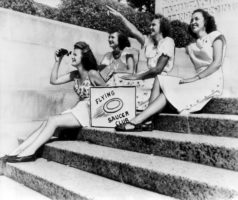 The very first flying saucer flap occurred during the summer of 1947. It began with the reported sighting of nine mysterious objects by pilot Kenneth Arnold on June 24 and hit its peak that July. This was the first, “summer of the saucers.” Much has been written about Arnold’s sighting but the sightings after that have been largely ignored. For the interested student of this period in U.F.O. history, there is a document available online that is well-worth reading. It provides a comprehensive account of the flap, citing a large number of newspaper articles that appeared during that time.
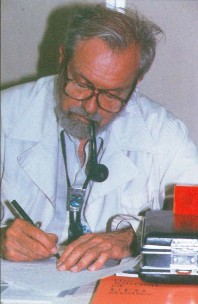 In 1966, there was a flap over Michigan that got the attention of the press and the Air Force. There was a great deal of excitement and Project Blue Book’s scientific consultant, J. Allen Hynek, was sent in to help calm things down. At a press conference, he offered some possible explanations. Due to sightings over a marsh, he speculated that people had seen ignited balls of swamp gas, some going out and others igniting and that this created the illusion of movement. The swamp gas explanation made the headlines, outraged many Michigan residents, including then-Governor Gerald Ford, and became forever associated with Hynek in the history books. Fortunately for Hynek, he had a sense of humor and was able to turn his gaffe into an entertaining talk at a celebration of the Michigan events, ten years later.
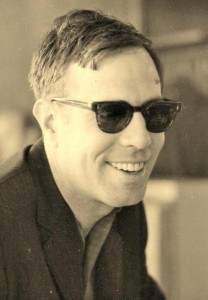 Among the early flying saucer investigators who stumbled their way through the mystery in the late 1940s and early 50s, there were some fascinating characters. Imagine being able to meet and discuss flying saucers with the likes of Donald E. Keyhoe, Edward J. Ruppelt, Frank Scully, Albert Bender or Gray Barker. A young man who did was James Moseley, who had more than a passing interest in the subject. With no prior writing experience or credentials, he convinced the most prominent people in the field to sit with him for interviews for a book he’d set out to write. He never published the book but found a place for himself in the world of flying saucers and saucerers where he’d remain for the rest of his life.