by Charles Lear
In our last blog, we looked at a case involving three women in Kentucky who experienced actinic conjunctivitis after a UFO encounter. Since the blog was about multiple UFO-related conjunctivitis cases, we focused on that aspect of the encounter, but there was more to their story – a lot more.
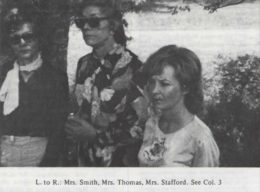 According to the October 1976 APRO Bulletin (date from February 12, 1976 Kentucky Casey County Press) on January 6, 1976, Louise Smith, Mona Stafford, and Elaine Thomas were all sitting in the front seat of Smith’s 1967 Chevy, which she had bought the day before. Smith was driving and they were on their way back to Liberty, Kentucky, where they all lived, after having had dinner at the Redwoods restaurant 29 miles away, five miles north of Stanford, Kentucky. They had gone there to celebrate Stafford’s birthday (they reportedly didn’t drink any alcohol) and left at 11:15 p.m.
They were about one mile south of Stanford when they spotted a large metallic disc-shaped object with a glowing white dome. There were “three or four” lights on the underside that were red and yellow, and “a bluish beam of light issued from the bottom.” The object descended from their right to left and then hovered at tree level over the road in front of them. At this point, they were able to estimate its size. Smith said it was “as big as a football field,” and Stafford said it was about the size of two houses. It gently rocked back and forth for a couple of seconds and then moved off to their left.
 For researchers, UFO trace cases make up a welcome, science-friendly aspect of a phenomenon that often eludes scientific study. Researcher Ted Phillips specialized in trace cases starting in the mid-1960s on the advice of Project Blue Book scientific consultant J. Allen Hynek. In the course of his investigations, Phillips was able to note commonalities, one of those being that soil samples taken from alleged UFO landing sites were unable to absorb water. While UFOs have been reported to leave physical traces on the environment, they’ve also been reported to leave physical traces on witnesses. A common report of this sort is what is medically known as “actinic conjunctivitis” or “klieg conjunctivitis.” This is a painful condition where the eyes become red and intensely irritated due to exposure to ultraviolet light.
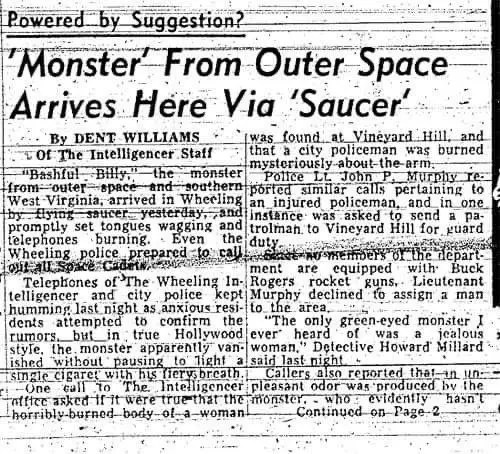 On September 12, 1952, a woman and six boys in the town of Flatwoods in Braxton County, West Virginia, reported that they’d had an encounter with a landed UFO and a strange creature. The woman, Mrs. Kathleen May, described the creature to a reporter as “a fire-breathing monster, ten-feet tall with a bright green body and a blood-red face.” She said the creature emitted an odor “like metal” that caused everyone to vomit for hours after the encounter. She added, “It looked worse than Frankenstein.” The witnesses all agreed that the figure had a red face with two openings like eyes that projected beams of greenish-orange light over their heads and that around the face there was a dark hood-like shape that came to a point like the ace of spades. The creature has become known as “The Flatwoods Monster.” By September 15, the case was reported in newspapers all over the country. It is likely that most readers are aware of this case, but many may not be aware of reports from nearby Wheeling, West Virginia, just a couple of days later.
 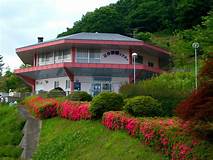 On June 24 of this year (World UFO Day), the International UFO Lab was established in Japan. It is housed in the UFO Fureaikan (UFO Friendship Center), a UFO center and museum that was built in 1992 in the town of linomachi (lower case spelling is apparently proper), which is now a prefecture of Fukushima. The facility is city owned and run by the Iinomachi Promotion Corporation. It was built using money from a regional development fund in an effort to help promote the area as a UFO hotspot after numerous sightings, starting in the 1970s, around nearby Mount Senganmori. The Lab is part of a new revitalization effort for Fukushima as a whole. Japan’s history of private UFO research goes back to the 1950s, but the official stance until 2020 was that UFOs weren’t worthy of consideration.
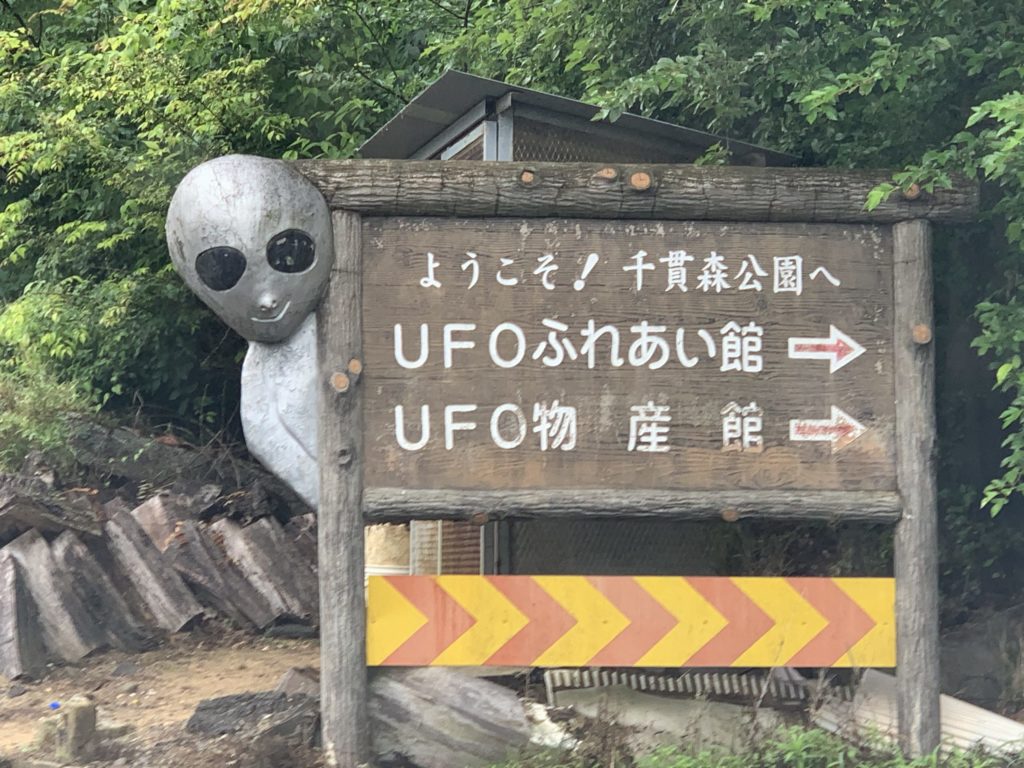 The material housed in the UFO Fureaikan comes from a donation of over 3000 items from early Japanese UFO researcher Kinichi Arai. Arai ran a bookstore in the early 1950s and developed an interest in flying saucers while reading books on the subject that were increasingly being published at the time. Arai felt there was need for serious discussion of the phenomenon and formed Japan’s first UFO organization, the Japanese Flying Saucer Research Association in 1955. Arai was a pacifist, and according to
  These days, more and more researchers are considering the idea that there is a unified theory for all things paranormal from Bigfoot to ghosts to UFOs. The idea that all, or at least many, things paranormal derive from a common source was