By Charles Lear
 The decade of the 1970’s was a strange one in America. The counter-culture of the late 50’s gained momentum through the 60’s and, by the 70’s, it had gone mainstream. Experimentation was everywhere in the arts, culture and politics of the era and the minds of the general population were open to possibilities that were, perhaps, beyond the capabilities of the science of the day to explain. It was a good time for UFOlogy and many documentaries on the subject started to appear in movie theaters that culminated in Steven Spielberg’s 1977 fictional treatment, “Close Encounters of the Third Kind.” The title of the movie comes from J. Allen Hynek’s system of sightings classification and CE3 designated a UFO sighting that involved beings. In 1973, CE3 sightings hit a peak and that year was designated, “The Year of the Humanoids” in a report published by the Center for UFO Studies, written by David Webb from files provided by Ted Bloecher. Both men were co-chairman for the Mutual UFO Network associated, Humanoid Study Group.
Webb wrote that from August into December of 1973, there were 70 reports in files available to him of humanoids associated with UFOs, with 55 of them being within the continental United States. These sorts of reports have always made up a small percentage of the overall reports and Webb acknowledged this. He went on to consider that, if one was to assume that UFOs are piloted extraterrestrial crafts visiting Earth, more could be learned about the visitors by studying them than studying the crafts. The first step, as he saw it, was to organize the sightings. Humanoids seen in association with craft were of primary interest followed by those seen in the proximity of UFO activity. Webb mentions contactee reports with caution, “monster” sightings and finally abduction reports. He distinguished humanoids from “monsters” and ape-like creatures such as Bigfoot, which he termed, “anthropoids.”
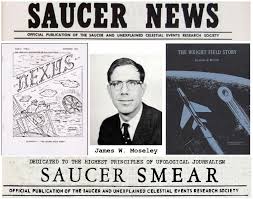 In the early days of the modern UFO era, if you were an American and you saw something strange in the sky and wanted someone to investigate, you reported it to the Air Force. If the Air Force dismissed your case as unworthy of study before 1952, there were no other organizations to turn to. There were a few private individuals who might be willing to look into it, but they were usually under contract with publications such as True Magazine, Look Magazine, and Fate, which meant that there would be some publicity involved. There was a need for a private organization of dedicated researchers and, by the end of 1952, three groups had formed to fill it. The first two were the International Flying Saucer Bureau founded by